
Canon in D
By Clay Hipp
Reflections on gratitude, mystery, and the strange gift of being seen
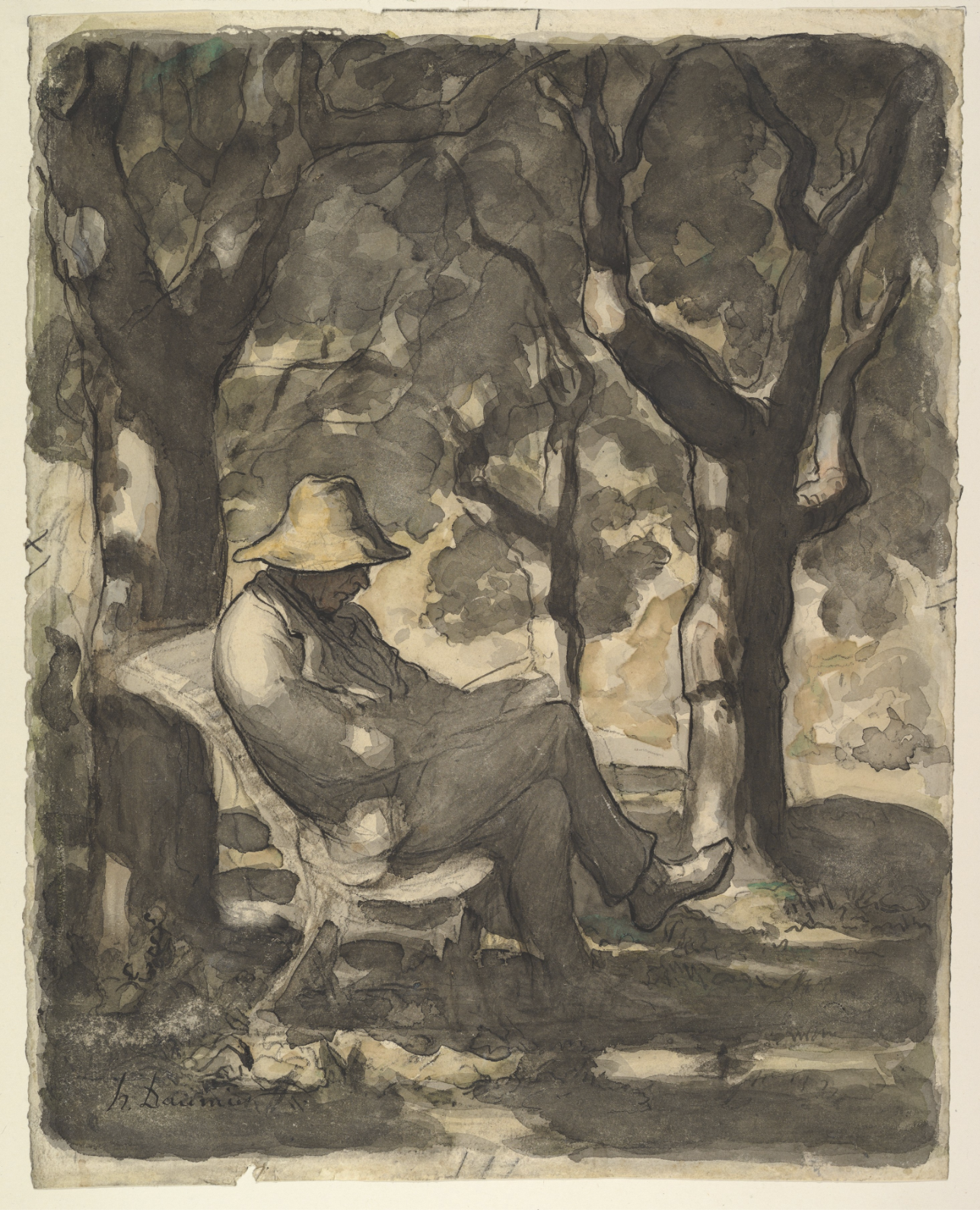
A Man Reading in a Garden, 1865, Honoré Daumier, French
Friday Morning, July 3, 2026
What does one say when rendered speechless and then brought to tears?
That is what happened, in more ways than one, on my birthday.
It all started the day before, on the 2nd. We went to breakfast at our favorite little neighborhood café. I got a phone call from my youngest son, who lives in Chile. In muffled tones, he let me know that he was in the hospital. A procedure would determine the reason for chest pains. He would let me know.
As we were leaving, Joanie received a message letting her know that her mother had been rushed to the ER and hospitalized. She was waiting for an MRI.
For the rest of the day, we waited for outcomes.
Fortunately, each turned out well, save for my son’s fully blocked artery, which was successfully cleaned out and stented. News like this does not land lightly. The words “successful” and “released from the hospital” are wonderful words, but they arrive only after other, more frightening words have wreaked their havoc on mind and soul.
Late that same afternoon, I received a terse e-mail ending a five-year relationship with a friend.
What a lead-up.
I hardly slept that evening and woke up groggy and disoriented. Coffee helped somewhat, and finally I was able to have a decent conversation with Saint Joan.
After a while, she led me into our small dining room for a surprise birthday gift. On my computer was a handwritten card directly from her. Along the wall, on a sideboard, were hundreds of photographs and much memorabilia from my eight decades.
After we had sampled them, she opened my computer to reveal a folder, hidden until that moment, full of e-mail messages. Quietly, behind the scenes, she had written to people from different corners of my life — family, old friends, former students, colleagues, companions from various chapters — asking them to send words, memories, stories, songs, whatever they wished to offer.
And they did.
One after another, the messages arrived, each from its own angle of affection and remembrance. They talked of diverse things: a classroom, a meal, a trip, a kindness, a conversation, a song, a phrase I had long forgotten. More than a few brought me to tears, Joanie as well, until we could read no more for the moment.
As I read and read, I quite often thought, “Who is this person they are writing about? I hope that I can become more like him over the next decades.”
Somehow he seemed made up.
It is grand, and also quite unsettling, to realize that people may have carried around some version of you that you yourself have never met. I am not being modest. This is how it felt. I kept thinking, “They do not really know who I am.”
But then another possibility began to work on me.
Perhaps they know something I do not.
Not the whole of me, of course (do we ever really know our full selves?). I think it is difficult because we live too close. We know our confusion, failures of nerve, impatience, selfishness; the unfinished work — the inner weather no one else can see. From the inside, our lives often feel partial, improvised, and unclear.
But in those moments, reading those beautiful, funny, heart-wrenching e-mails, I realized that people saw me from another angle.
They remember a sentence I’d forgotten. A class I barely recall. A meal. A concert we attended. An e-mail I wrote over class break. A conversation in a café. A book placed in their hands. A question asked at the right (or wrong) time. A kindness given when needed. A moment that, to me, was just a moment passing, but to them, somehow, became a part of who I was.
What a strange gift.
Beautiful, but strange.
It is one thing to live your life. It is another thing to have it sung back to you.
I will say this: it was the perfect antidote for what happened on the 2nd. The contrast between the two days, and the emotional tide that came in and was now going out, left me spent — awash in gratitude and emotions I did not have words for.
Right now, I am listening to Pachelbel’s Canon in D.
Yes, that one. The wedding one. It became so popular in the ’70s, and played and covered so often, that for many it became trite and actually derided by some. A shame.
If one reads about its structure, one might be fascinated to learn that the strings and continuo play repeating harmonies over a basso continuo that repeats over and over throughout the calming and almost mesmerizing composition.
Underneath all those soaring strings, there is a bass line. Eight notes. It simply repeats — over and over, from the first measure to the last, never changing, never hurrying. Everything beautiful in the piece happens on top of something that holds.
Maybe a life is a little like that.
There is some line underneath us, some pattern of character or habit or hope, some way of returning to the world, that repeats so faithfully we may hardly notice it ourselves. We get up, make coffee, read, cook, teach, listen imperfectly, ask our questions, fail one another, repair what we can, and begin again.
The bass line is not dramatic. It does not say, “Look at me.” It simply holds.
But then others enter.
They bring their own melodies. They remember the phrase, the meal, the class, the song, the invitation, the argument, the book, the joke, the hours together at the table. They take something from that steady line and carry it forward in a way one could never have predicted.
And suddenly, on one’s eightieth birthday, one hears not only the bass line one has been trying, imperfectly, to keep, but all the music that has risen from it in other people.
No wonder it was overwhelming.
Martin Buber wrote about the difference between I-It and I-Thou — between treating another person as an object to be measured, used, or categorized, and meeting that person as a living presence. I have always loved that distinction, though I cannot claim always to have lived up to it.
But what these letters gave me was not praise, exactly. Praise can be dismissed. Compliments can be batted away by any reasonably skilled old crank.
This was harder.
These letters were acts of recognition. They were people saying, in one way or another: you met me. You saw me. You gave me something, and I carried it forward.
That is not easy to take in.
It may be easier to believe the harsh word than the generous one. Easier to believe the broken relationship than the hundreds of remembered kindnesses. Easier to believe one’s private accounting than the testimony of those who have stood nearby.
Perhaps this is why we need others. Not to inflate us, but to show us what we cannot see from the inside. We know the turmoil and the unfinished work. They see the shape our trying has made.
If you have not listened to the Canon lately, or ever, give it a try. I just heard a piano version by the contemporary artist George Winston. I had a female colleague in New Mexico who had a CD with a dozen or so versions. She told me that her mystical “key” was D.
OK, who am I to argue with that?
A question: what do you consider your greatest birthday gift ever?
I need look no further.
The time and effort put in by my uber-caring Joan, and all the thoughtful and eloquent responses from friends and family, have value beyond measure. They gave me something I did not know I needed. They allowed me, for a little while, to hear my own life from where they stood.
I am still not sure I recognize the person they described.
But perhaps I do not need to argue with them. Perhaps I need to receive him, with gratitude, as one receives a melody one did not know had been playing.
I would like to grow up to be more like the man they saw — and to be worthy of the generosity with which they saw him.
What am I to do when they have a significant birthday?
Message: each of us may have our greatest value through the eyes of others. Think of that when you encounter those around you. At the very least, acknowledge their existence. Give them a greeting. And if you ask, “How are you?” mean it.
You may be offering them a glimpse of themselves they could not otherwise see.
You may be helping them hear the music of their own life.
That is what I am trying to do now, imperfectly, at eighty. And that, I think, was the greatest gift I received on my birthday: the gift of being seen.