
No One Is an Island
…entire of itself
If I am asking you to spend some of your precious time with me, I feel a need to share more about the life experiences that inform me.
Each of us at any stage of our life is an amalgamation. Someone has said that “memory is mind”. We have relationships. As we grow, we develop preferences. Information flows in relentlessly from many sources. Our personalities are formed and molded and recast continuously. If we are fortunate, there are more positive impacts than negative. At some point we stand naked and vulnerable to all who choose to encounter us. This can be frightening or exhilarating or simply boring and mundane.
If we are brave, we come accept and live within this reality. In the coming weeks, I shall “expose” some of the forces that memory tells me were among the most formative. Eventually, I will reveal figures from music, literature, and family that feel essential parts of who I have become. I shall begin more “humbly”.
In the small mill town of my youth, I attended with regularity the church one block from our house. My mother’s father was a Methodist minister so that was our choice (instead of my father’s Baptist congregation one block in the opposite direction). In that church there was a regular looking guy and his lovely wife. In middle age they remained childless. He invited the young boys to join him on Saturday morning hikes in the surrounding woods. The woods were a part of a national forest so there were very few limitations on wandering once we left the town limits.
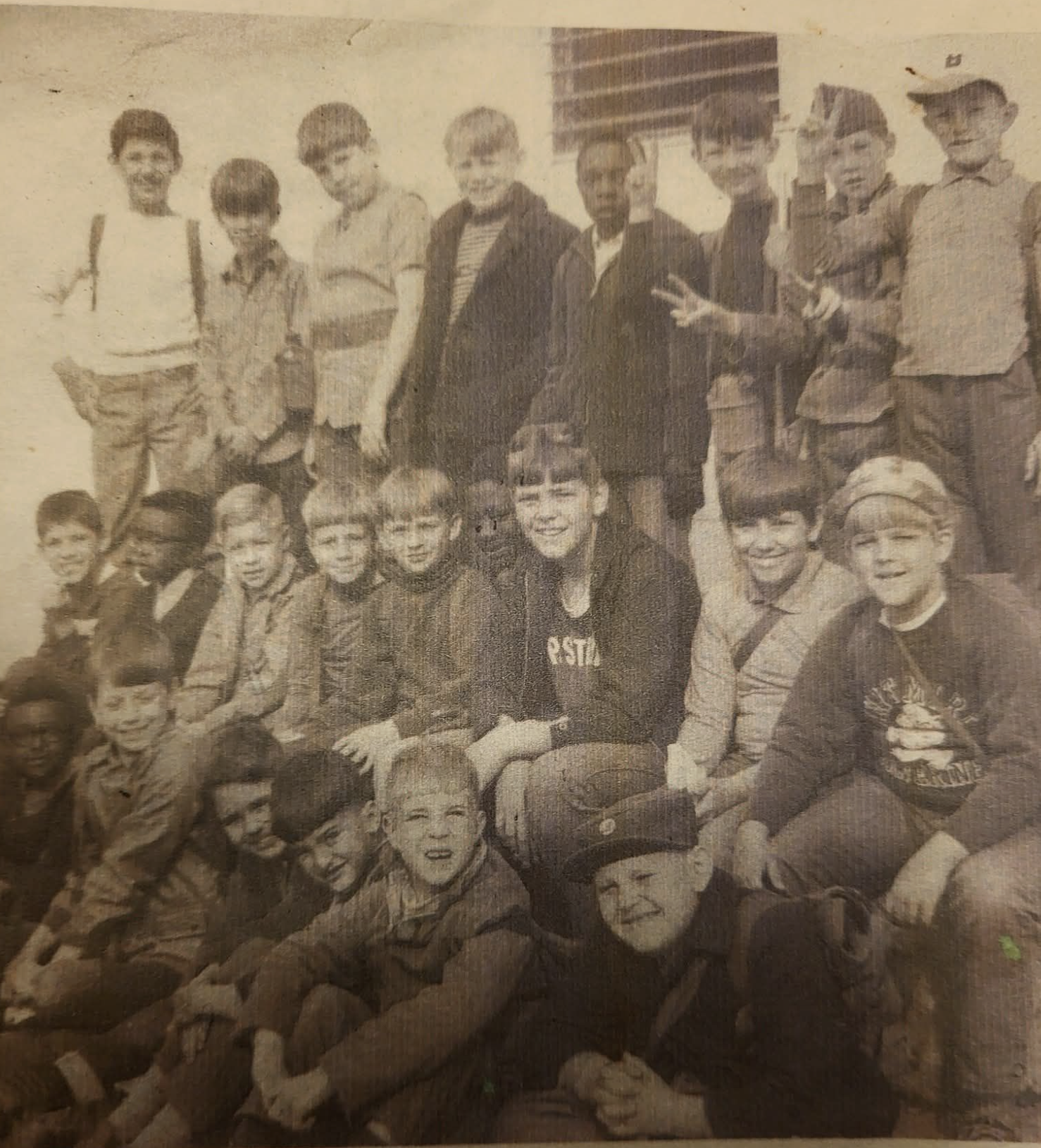
A Group of B.F. Poole’s “Junior Minute Men”
B.F. Poole (Benjamin Franklin to be exact) worked in the textile mill for eight hours, five days a week. While many of my friends’ parents chose to rest or play during their free hours Mr. Poole and his wife spent Sunday at the church, and he dedicated Saturday mornings to his young minions. None of us knew where he intended to go or what we might see—that was a delicious part of the outing. I wish I remembered more, but I can give you a few snatches.
Usually, we followed the Seaboard Coastline railroad tracks for a mile or so to escape sidewalks and traffic on the country roads. It was exciting to cross Duncan Creek on the high bridge never worrying about a coming train (I am sure Mr. Poole had checked the schedules meticulously. He certainly felt the responsibility he had taken on, even as we felt free as birds). Once we were in a low, damp forest floor, he held up his hand to stop. He had seen something that might spell danger. In a moment he motioned us to follow and pointed to the ground. Distinct footprints, not human or resembling any usual animal, tracked across the damp floor. He squatted and told us to look closely so that we would remember— the hoof prints of a pack of several wild hogs. He told us that they raided gardens and damaged fences and did not take lightly any attempts to deter their wants and needs; they had sharp tusks.
Much later as an adult I was canoeing a black water river in eastern North Carolina with an outdoorsman friend, and we startled a pack of 30 or so on the bank. With a loud snort from their leader, they crashed wildly through the underbrush. I recalled Mr. Poole’s warning and teaching.
Another time in early summer, we rode in cars to another branch of Duncan Creek, stopped and climbed down a slope to a sandy spot next to the water. He broke off a stout branch, sharpened it with his pocketknife, stuck it deeply into the sand, and proceeded to roughly vibrate it by rubbing another against it as if trying to start a fire with the friction. A minute or so later worms began to emerge from the ground around the spot. We were astounded to watch thirty-inch-long slimy worms emerge as if summoned like an Indian Cobra—we learned that they were called “nightcrawlers”. Big enough to entice a large mouth bass if you could somehow got them on the hook.
Exhausted by the hike in and as sweaty as the worms were creepy, Mr. Poole allowed us to strip down and swim in the creek. The first act of “skinny-dipping” in my life. I shall reveal nothing more.
Mr. Poole joined us in youth meetings and summer Bible-school and became more like a gracious uncle, a fine alternative to whatever home life we experienced. When not in the woods one would regularly encounter him on a bench downtown in front of a gas station, always there to talk or merely listen. For some of our older members he invited them home to learn the art of tying flies and crafting elegant bamboo rods.
I tried, in adulthood, to contact him but found that I was too late. I did not get to say thanks or tell him how grateful I was. That taught me his last lesson—do not put off the most important things in life. There in a small, insignificant village a local hero bestowed on a tiny band of budding teenagers a model of responsibility and care, a gift that we hardly realized. My fervent hope is that I was not the only one whose life bore a small portion of his character.
I do not remember any great sermons or revivals, but that little church nurtured us in the membership and community.
Amen.