
When My Writing Life Was Born
By Clay Hipp
Leaving the classroom, Entering a sentence
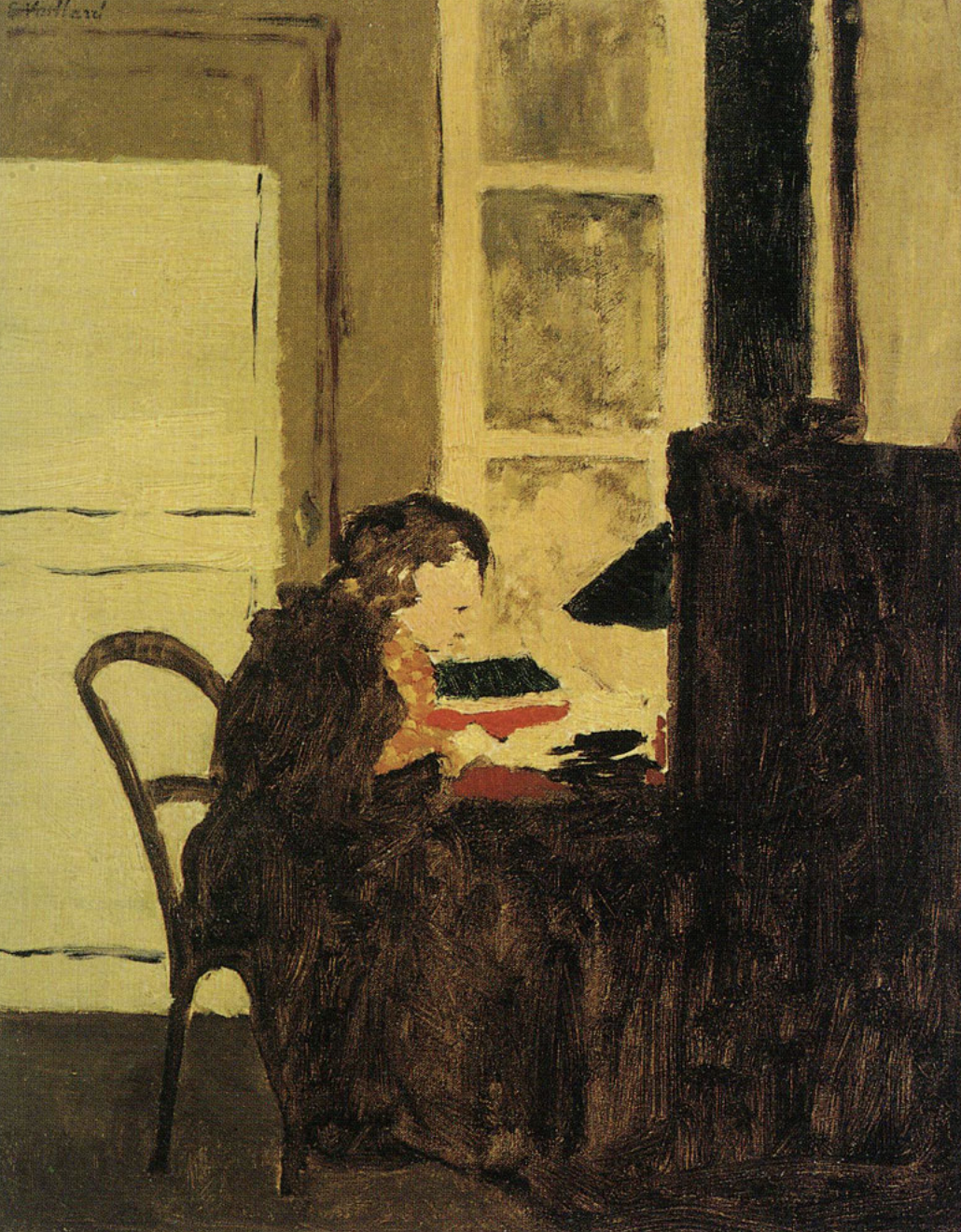
The Writing Desk, Edouard Viullard, 1892
As I was leaving teaching and wondering what was next, I asked myself what else I could “do.”
I play golf, and used to play the guitar, and grew pretty good heirloom tomatoes, and once cultivated a vineyard, and read a lot.
Did those constitute the makings of a proper “retirement”?
Perhaps that is enough for one person to DO, but does it provide anything of use to others?
Then, I thought, that is a lot of stuff—any chance of combining any of it for a meaningful retirement?
Let me think.
What, if anything, have I done but stand in front of a group of students and try to further my worth as a faculty member by writing, presenting, and publishing about an esoteric subject called “the Legal Environment of Business”? The classes were gone and who, but close colleagues, want to hear your most recent musings on “antitrust,” for instance? If I had stayed in practice, there might have been a chance of going to the Supreme Court to “change the very law itself,” but as it was there were only juries for an audience—and another next week.
Quite promising… and eminently exciting.
A dead-end road, a box canyon, a very wide gulf… a comfortable rocking chair?
In the end, having a bit of luck with publishing, it seemed that passing through editorial hell must mean something about my writing ability. My main concern was that there was very little creativity involved, only grammar and coherence and a little persuasive ability in professional papers. Could I really write for a literate audience?
I consulted a few true writers who had written “how-to” books. Some helpful hints, too much “showing” and “examples,” and much of it seemed tied to personal material and traits.
One particularly pointed piece of advice for “beginners” seemed to be “write what you know.” That was appealing and made practical sense. So I began to think about things that I knew from experience. My loving partner (and future “editor”) had encouraged me to share my life story with my kids and future grandkids. Finding no better place to start, I started from the beginning—my childhood. Much of what I was writing at the start (I now know) was extremely narrative, facts upon facts.
As I proceeded, my “story” seemed to be getting smoother, less formal. I began, if nothing else, to feel that it was becoming easier to make the prose “flow.” My thoughts were translating into words and, at the same time, the thinking was happening with less effort. So, I wrote regularly, and the pages began to accumulate. Better yet, I realized that there were stories to tell; small towns have lots of characters.
I realized that I was starting to actually have fun!
Maybe the best part of it all was that in writing about what I know, I was finding out what I did not know, and that I was remembering things that I had forgotten. I know enough from other sources that what I was doing was bringing old memories back to life, retrieving them from lost, unused banks. What a revelation to know that I was somehow bringing things long gone “back to life.”
Recently, it occurred to me that I had not shared much of this document with my boys. The reason, perhaps, was that some of what I had written seemed a bit too personal and revealing. Now, I think that my middle-aged sons can be trusted to receive it for what it is. They certainly know by now that I am not perfect. I make plenty of mistakes and second-guess myself just like everyone else, and by sharing it, I am demonstrating trust and just being human.
In addition, when I read it now, it does not seem too bad!
Lesson to self and to any budding writers: there are many fine things about writing that may not be obvious until one does it. Another: you might just rekindle reasons to return to reading good literature. The most important? You will never know good writing until you read the best. It will inspire and ignite the writer you are capable of becoming.
Just some further incentive.
I had never really considered writing works of fiction. I am, in my oral life, considered to be a good storyteller. That comes, I think, from my years as a teacher and the need to be spontaneous on my feet, and having the need for providing context for in-class pronouncements. I also come from the rural South, with front porch talk and much oral tradition. The thought of “making up” stories seemed unnatural and hard work.
Just to let you know, that can change.
It happened this way for me. For twenty or so years, I was absolutely smitten with a story song written by one of my favorites, John Gorka. I liked it, and the concept behind it, so much that I could not get it out of my mind—I wanted desperately to know where it came from, the inspiration behind it. Ultimately, I decided I would just have to “make it up.”
So, I did.
I pretended that it was from an actual story. I gave it a fictional context and pretended there was an investigative reporter who got wind of a controversial news article and proceeded to follow the story for his readers (you know the type; the story must be of significant human interest).
Well, by the time I wrote it, I had fantasized for years, and it just came rolling out, effortlessly—the easiest writing one could hope for. I had fun, and when it was finished, I needed to share it. Too shy and afraid of its reception, I just put it aside. Finally, I sent it to the person who had written the song, called his agent and asked if the writer might talk with me and, lo and behold, he liked it and we talked over the phone.
That should have been enough for this novice, but “noooo”!
One of the characters refused to go away. She had more story to tell; she was adamant! So, I set about satisfying her thirst to live. I told it, but lo and behold, one of the new characters demanded equal time for HIS story.
Bottom line?
Unbeknownst to me, it had become a novel.
Do not get excited. I got the big head, submitted it to a small, independent publisher, who responded:
“This is to acknowledge receipt of your manuscript. We will review it and let you know within six months of our interest. If you have not heard within that time, assume that it will not meet our needs.”
I heard no more. It has lain in limbo ever since. I decided that I would never let an editor ruin my year again.
I have read too many stories since then about authors who have received many, many such results.
Not for me.
Thank goodness I am not a professional. I will stick to my leisure.
Perhaps, I will choose to serialize the book for you, noble reader, and take a chance with the reviews.
Moral of the story?
Sometimes it takes decades to become qualified for the work that actually matters.