
A Life in Words and Music
By Clay Hipp
How folk music found a South Carolina boy in the summer of '64
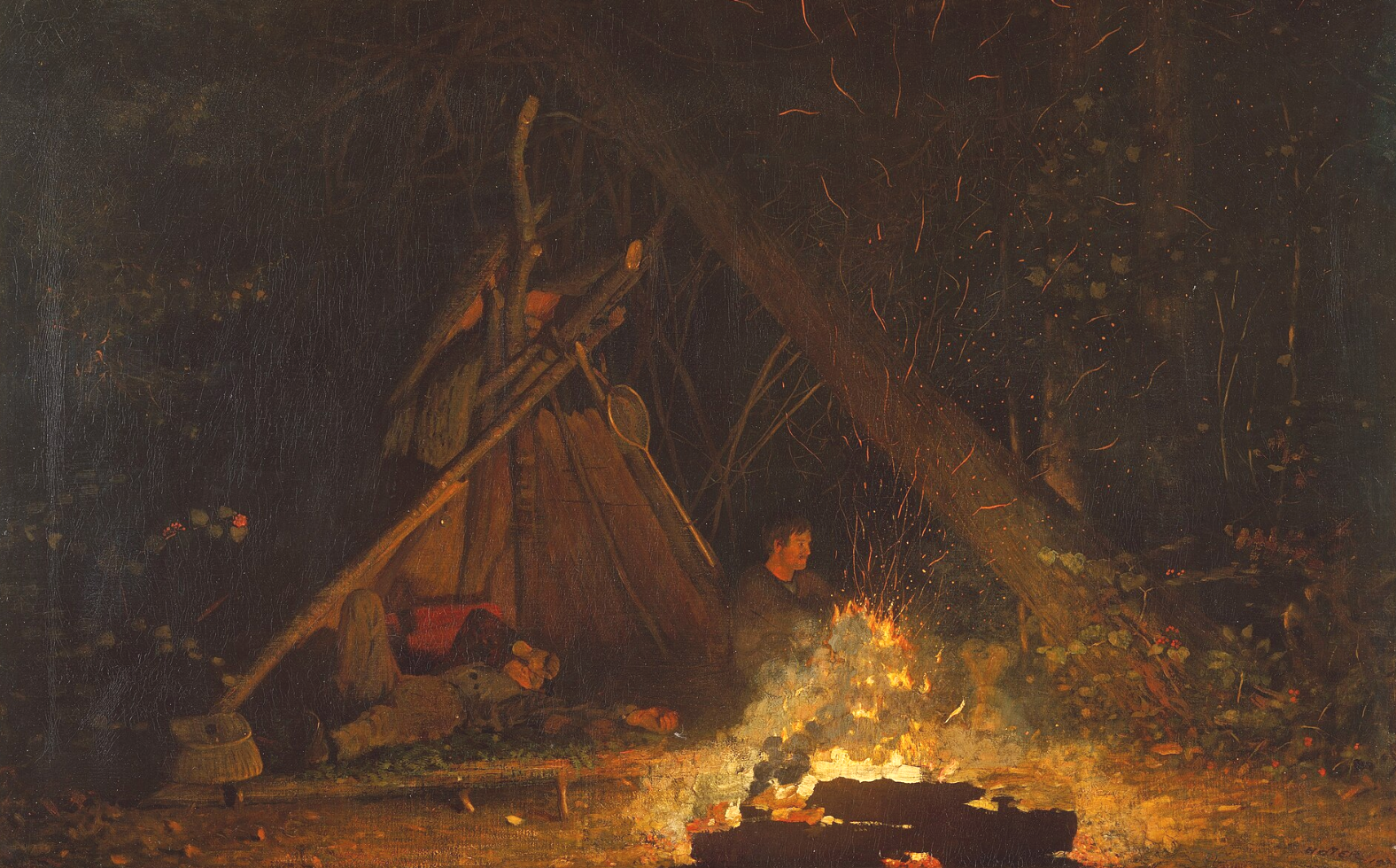
Campfire, 1880 - Winslow Homer
Answer the question—what got you started in your love for songs?
I was a folky in the sixties. I was learning to play the instrument of the times—a gut-strung six-string guitar. The first stirrings of rock and roll in the late fifties had had their fling on the hit-parade radio shows; Elvis and, later, the Beatles turned up on Ed Sullivan.
And then, suddenly, folk music. The summer of 1964: a guitar, summer camps, campfires, Bob Dylan coming over the airwaves, beautiful romantic songs built on three easy chords.
The first big revelation
The world was suddenly full of accessible tunes and lyrics, played on guitars with as few as three easy chords. They called it "folk music." Why?
Because it came from us, was sung by us, and we played it to—and with—our fellow human beings.
I was on a college campus in Columbia, the capital of South Carolina, just fifty-two miles from my little hometown, attending what was for me a big event: a gathering of high school students from all over the state. We came together for a week in July to meet in small groups, attend large assemblies, sing, and yes, worship. We were Methodists—the church of my mother and of Pop, her very fine minister father. I was full of my graduating self, fresh from the beach with my bleached-blond hair (sun-induced, with a little help from lemon juice). A decent athlete, MVP of my baseball team, I was truly full of myself. The new kid in town.
On the way to the dining hall for lunch, I passed someone carrying a true "boombox," out of which poured a genuinely magical song with odd lyrics. My first dose of Peter, Paul and Mary, lending their fine harmonies to a song written by the great Pete Seeger (with Lee Hays). "If I Had a Hammer." The rhythm was compelling, the three-part harmony ethereal. I had no clue it was my very first protest song:
“If I had a hammer
I’d hammer in the morning
I’d hammer in the evening
All over this land
I’d hammer out danger
I’d hammer out a warning
I’d hammer out love between
My brothers and my sisters
All over this land”
Before the summer was over, I had learned the chords, more or less mastered the rhythm, and memorized the words. I played it with a new friend on banjo at yet another youth gathering up in the Smokies. It was a minor hit with a couple of young ladies.
The hook had been set too deeply to remove.
An hour-long weekly Saturday-night TV show was a huge development. It was called Hootenanny—which became the word itself for gatherings of singers and players of the new music. Everyone could join in, somehow. The flower-child era had begun.
Curiously, I first learned Bob Dylan's music not from his own recordings but from covers by Peter, Paul and Mary. After "If I Had a Hammer," I fell hard for one of the quintessential protest songs:
“How many roads must a man walk down
Before you call him a man?
How many seas must a white dove sail
Before she sleeps in the sand?
Yes, and how many times must the cannonballs fly
Before they’re forever banned?
The answer, my friend, is blowin’; in the wind
The answer is blowin’; in the wind”
The chords were easy. I memorized the words and made it my first "theme song." The poetry was sound, the message clear. What more could a budding folk singer need? Besides, it felt cool to be joining the "movement."
Some of the ones who shaped it
Folk: Woody Guthrie, Pete Seeger, the Kingston Trio, the New Christy Minstrels, the Brothers Four, Dylan, Joan Baez, Peter, Paul and Mary, Simon and Garfunkel—the list could go on and on.
Folk rock: Crosby, Stills and Nash; the Byrds.
That cast, almost literally, began to define the depth and breadth of the explosion of popular music—in quality and quantity—for the coming five decades. I have been extremely fortunate to live inside that revolutionary time. Timing, as they say, is everything.
The only way I can really show you how it felt is to let you listen. A beginning of a playlist:
"If I Had a Hammer"
"Blowin' in the Wind"
"The Times They Are a-Changin'" (Dylan)
"We Shall Overcome" (Joan Baez)
"A Change Is Gonna Come" (Sam Cooke)
"Where Have All the Flowers Gone" (Pete Seeger, covered by many)
"Requiem for the Masses" (the Association)
"Ohio" (CSNY)
Simon and Garfunkel
the Byrds
"Massachusetts"
And this one, long my private "national anthem," from the king of folk songs, the great Woody Guthrie:
This land is your land, and this land is my land
From California to the New York island
From the redwood forest to the Gulf Stream waters
This land was made for you and me
As I went walking that ribbon of highway
I saw above me that endless skyway
Saw below me that golden valley
This land was made for you and me
I roamed and rambled and I followed my footsteps
To the sparkling sands of her diamond deserts
All around me a voice was sounding
This land was made for you and me
When the sun comes shining, then I was strolling
And the wheat fields waving and the dust clouds rolling
The voice was chanting as the fog was lifting
This land was made for you and me
The chorus, all by itself, is one of the finest sing-alongs ever written.
I was seventeen when the hook went in—seventeen and full of myself, certain I had the world by the tail. It still catches me off guard, how a few bars can transport me back to that summer as if I'd never left. What I have now that I didn't have then is the long view: the gift of knowing, more or less, how the story went.
That is the strange mercy of these old songs. They don't stay behind you where you found them. They grow up alongside you, quietly, and hand you back your own memories when you need them most—which, I have learned, is more and more often the older you get. I find myself longing for that time now, though in a gentler key than I once did.
But maybe that is the whole gift of growing older: you finally get to stand back far enough to see the arc of your own life, and to look on it with something like tenderness.
I'll play them all one day on Words That Sing.