
A Meditation: As Far As the Eye Can See
Looking back across the centuries: what the “great guide” taught me about the liminal space between knowing and unknowing
By Clay Hipp
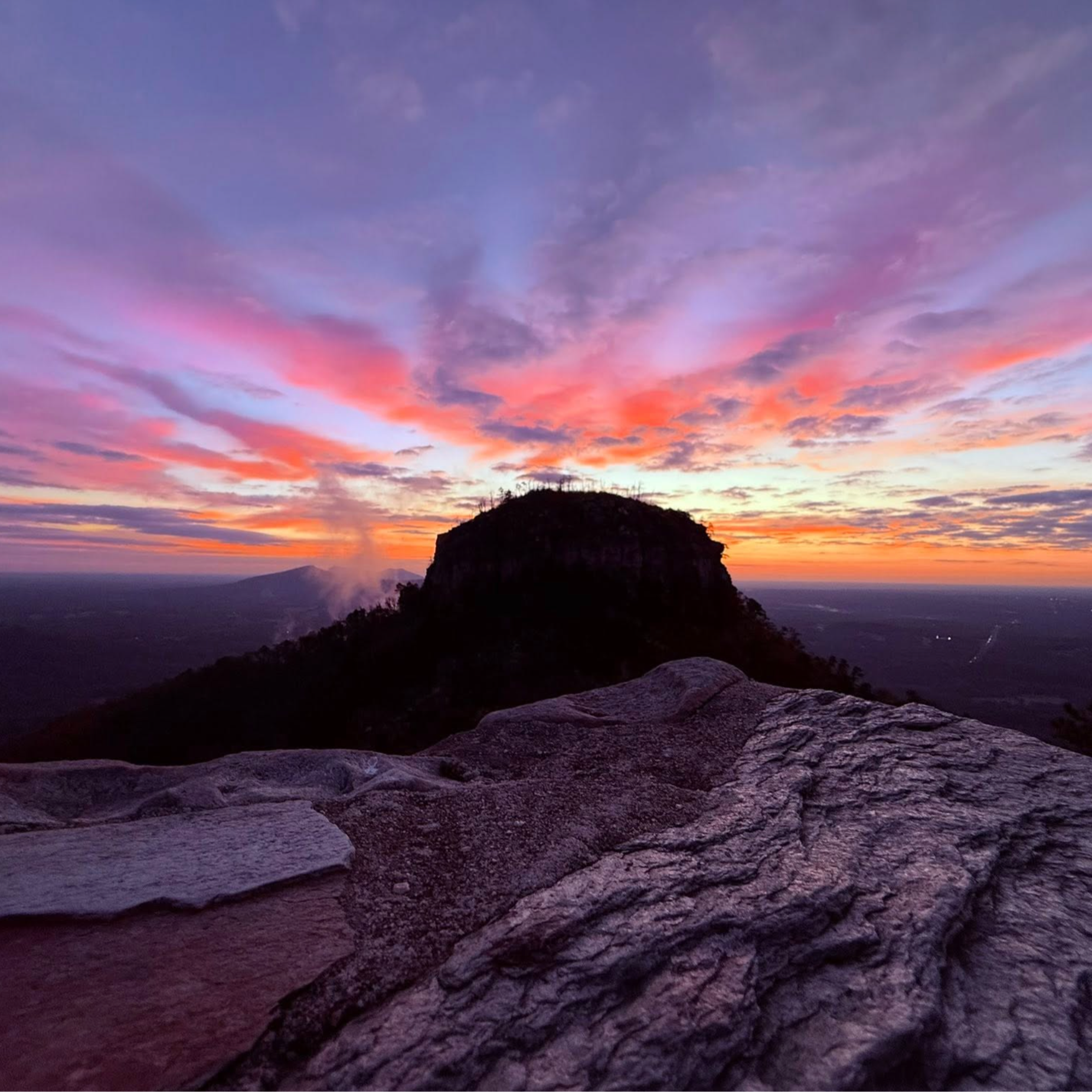
Imagine that you have camped under the stars on the pinnacle of a small mountain that rises from the relatively level plains of the Carolina Piedmont.
Because it is at the very end of an ancient mountain range, there is a 360-degree view of the Blue Ridge to the northwest, and the farms that surround it, and its sister peaks to the east.
Waking early, there is complete darkness…..
As the sky begins to lighten, the blue hour begins—a period that is neither dark nor light—and ends with the rising of the orange orb at the eastern horizon.
Almost suddenly, the whole sky is ablaze with red.
If one looks to the west, you have a view to the peaks of the range that stretches from north Georgia to the White Mountains of northern Maine.
The phenomenon is “as far as the eye can see”, in this case, around fifty miles.
The native name for this big hill translates as “the Great Guide.”
The people who were here well before our appearance used it as a landmark for traversing the many trails they followed for trade and hunting and fishing and interacting with similar people.
If one tends to be introspective, the new day symbolizes the fact that yesterday is gone but not forgotten, and wonders what this day might bring.
More deeply, they might see the past as it slides away (and the lessons learned), and the promise of a future that is completely in their hands to create.
This is the gift that a true encounter with what our natural world can provide.
One might also say, let this moment “guide” me as a map for my very own precious life.
Now imagine looking due east along the spine of the rest of the range as it seeks to join the Blue Ridge in Virginia.
Valleys, fields, and forests on both sides.
If one looks carefully, they might get glimpses of rustic shelters of wood and grass and animal skins, sometimes set against the slopes of granite cliffs, and perhaps caves, where the native people lived and worked.
One might be able to trace trails along the forests and fields.
We know they were there because when farmers plow their fields today, they often unearth beautiful arrow points of native quartz.
The experts who made them had a purpose, but they often show signs of artisanship as well.
Growing up, I knew a man who had a huge collection.
He displayed them on canvases and hung them around his house.
As a group, they were impressive.
He asked that I look at and hold them.
He had talked with experts who claimed that they could see the similarities, but also distinguishing styles.
They speculated that each “artist” expressed them differently.
A thing that is useful could also be beautiful, both at the same time.
Perhaps this reveals much.
Fast forward to the 18th century.
From the same vantage point, you might see streams of wagons and animals and people traveling paths and dirt tracks from north to south along what became known as the Great Wagon Road, seeking new “opportunities.”
They would settle in the Appalachians and the Piedmont of the Carolinas and north Georgia (my Scots-Irish and German ancestors).
In the early 21st century, one might gaze due east across the interstate, and see a small triangular field against a group of hardwoods and notice the orderliness of row after row of what looked like fences covered with vegetation.
Grapevines—mine.
If one spent a few days helping out, he or she might observe wild turkeys, groundhogs, does and fawns, and hear overhead the beating of wings and the cries of red-tailed hawks and the occasional pileated woodpecker (which are the size of crows and the largest since the extinction of ivory bills in the swamps of Louisiana).
On the vines themselves, “helpful” praying mantises and ladybug beetles (they both eat aphids).
Before my vineyard came along, the red clay and quartz soil grew what the farmer next door called the “best tobacco” he ever harvested.
That little mountain has seen a lot.
Can you see why Jomeokee is a sacred place for me?
Late in the afternoon (of which I spent many), if one watched the sun descend, it appeared to be making a landing directly on the peak, “a spaceship,” one might say.
It hurts me to know that moments such as these have so little value to many.
As a matter of fact, perhaps they might even be considered a “waste of time.”
Just think of what one might actually “do” with their precious time!
Jens Kruger has given us a little tune that speaks directly to this thought, which he calls “Beautiful Nothing.”
On first listen, it seems simple enough.
On the second or third, you notice something that you had only noted but wondered about—about two-thirds of the way through, there is a brief pause of perhaps ten seconds.
Is it over?
Then the music returns…just where it had stopped.
What moved the composer to do this?
More listening did not provide a clear answer.
Other composers have been known to intentionally “surprise” their audiences (Joseph Haydn is best known for this in his Symphony No. 94 in G Major, composed in 1791, commonly nicknamed the “Surprise Symphony”).
Was this Kruger’s idea?
I have come to believe, knowing him slightly, that it was the true message, hidden in the title.
The pause was the equivalent of the poet’s method of leaving something “unsaid,” which actually makes verse so different from narrative prose.
We are given the gift of reading between the lines, reflecting on the theme, rather than being “told” everything.
The rational portion of our brains wishes to explain everything; the creative mind is aware of “not knowing” and asks questions rather than giving answers.
In other “words,” my truth of the composition is that silence—pause—allows one to search for meaning and is the place where “beautiful nothings” reside—yours and mine.
I consider those few minutes as the sun sets behind the pinnacle as a “beautiful nothing” moment, to be experienced with new eyes and ears.
What more does one truly need?
How has appreciation of the natural gifts from the earth fallen so far down the scale?
Say what you will, “beauty” has its own throne in the earthly kingdom.
Our truest “knowledge” arises from and teaches us all the natural wisdom we need.
Everything else is “artificial.”
I mentioned earlier the native name “Jomeokee” (JO-mee-oh-kee) means “great guide” and was translated to “Pilot” in English by settlers.
I am moved by thoughts of our native brothers and sisters as they still occupy the fields and forests around the base of the little mountain.
I can also imagine my Scots-Irish and German ancestors as they encountered the trails and blessings of still wild and mysterious country, looking at the road ahead and being comforted to be shown the way toward what they hoped would be their special “promised land.”
Would that we all should read and learn from the history and stories of those who came before and helped form the beginnings of our American (native and immigrant) Dream.
And in the process, let it guide you towards your own a better place to be…
A Poetic Wish
The beginning of each day is neither red nor blue.
It is, however, as we choose to see it.
Being “betwixt” and between, we sometimes feel lost…
Is there a middle ground
Where we might meet as equals
And speak as brothers and sisters
And blend our beings into new forms
Of togetherness…?
Despite the fact that it seems, at first, a “purple haze”
That blurs our vision, it can yet reveal truth
Rather than allow conflict to remain amongst us
Is a new dawn possible…and
Who will work to make it so?
We need to go as far as the mind can travel…
—E. Clayton Hipp, 4/2/2026, at home