
Is This the End or a New Beginning? The Love That Might Remake Us
On Greene's Sarah Miles, Merton’s epiphany and whether compassion can still bridge our divide
by Clay Hipp
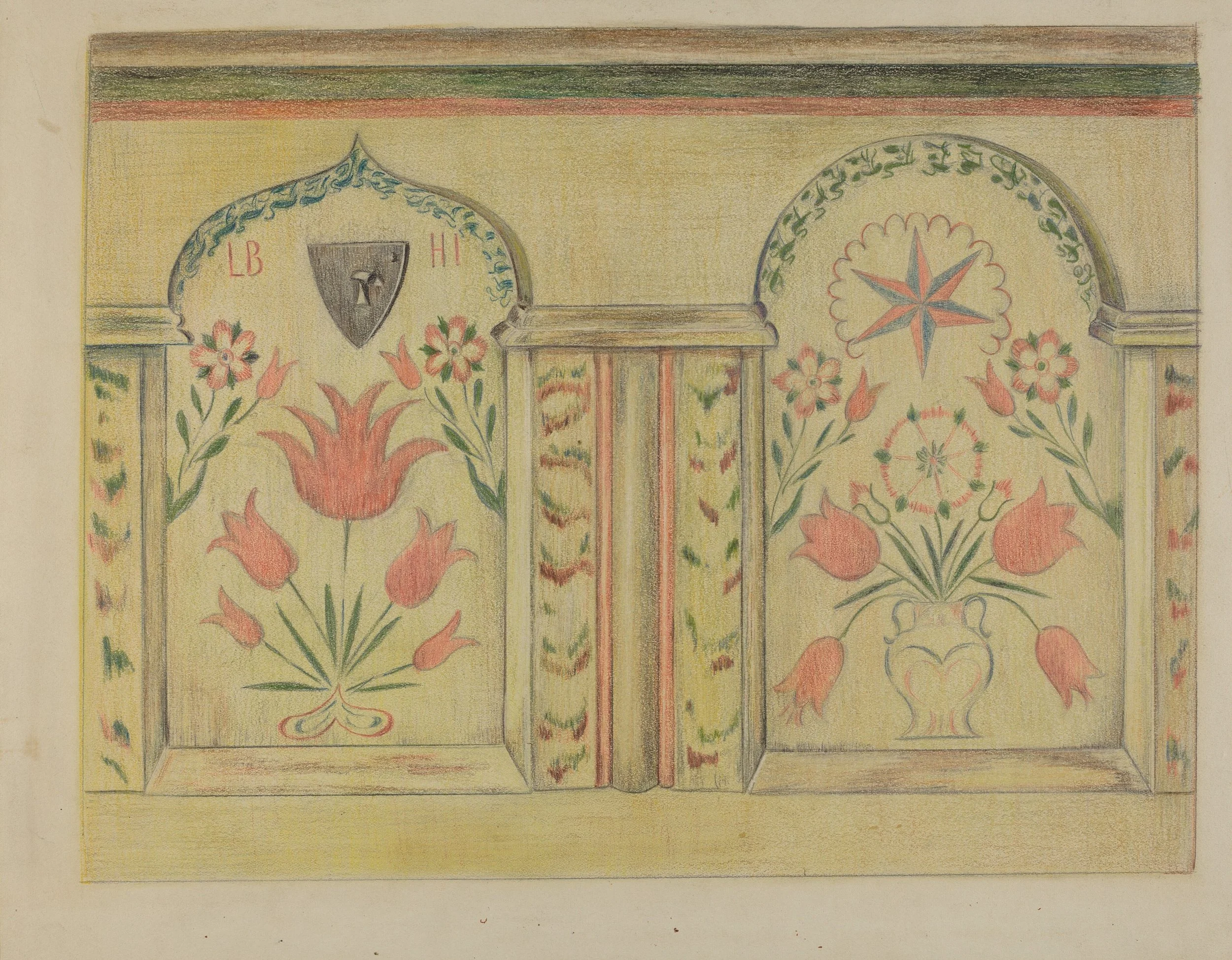
German Love Chest, Ella Josephine Sterling 1935
“When did The Land of the Free
become The Home of the Afraid?
Afraid of the world, afraid of the truth,
afraid of each other.
This ain’t the country my grandfather fought for, but I still see the hate he fought against.
Give rest to the tired, give mercy to the poor. Give warmth to the huddled masses
And I’ll show you freedom.”
All right, am going to give this one more try.
The country we love ……and care for……. no longer exists.
It is gone but not forgotten—it is still a wonderful “idea” to embrace, hold onto.
Just now, it is divided against itself. We are being ripped asunder by two extreme factions who do not even seem to be able to speak to each other. They can only point at each other, blame one another for the shape we are in, and put labels on the other: there are “deplorables” and “elite leftists”. With this approach, nothing will ever get better, only worse. They feed on each other’s dislikes and say that “your” actions prove their point. Neither faction can create a consensus, nor govern us.
We cannot continue to claim different “truths”. Social justice and individual rights are simply two sides of our national “union,” which makes the notion of “equality” a significant challenge. Where does hope for the future lie? In the center, where our basic “values” reside. (Home, family, beauty, care, community, the wisdom of the natural world, a belief in something larger than ourselves.)
As it is, I am afraid that “hate” actually exists in both camps among the most radical elements. Certainly, there are disagreements over preferred “policies,” but I sense very little conversation over those. It is mostly about personal identity which, currently, is the primary basis on which loyalty to political parties is based. Crossing over is nearly possible.
OK, enough analysis.
If my observations are correct, much of what is happening is generated, at its core, by built-up, extremely negative, personal and emotional enmity which always borders on hatefulness.
How can we possibly find, extend, compassion for one another?
Only if there is still a residuum of what is sometimes referred to as “brotherly love”. Is love only about special individuals or within families? Is there a force that is as strong as hate to counterbalance what I have been trying to describe?
Honestly, one should be able to discern that I do not know.
Perhaps a couple of anecdotes will aid our quest (and perhaps give us hope for our future as a, currently “disunited”).
How does “Love” Work? Ponder this:
“In Graham Greene's novel The End of the Affair, the narrator, Maurice Bendrix, describes Sarah Miles as having a distinctive way of interacting with others, noting her 'way of touching people with her hands, as though she loved them"
This habitual gesture is one of the first things Bendrix notices about Sarah, reflecting a natural capacity for warmth, even before the deeper, more spiritual shifts in her character occur.
Throughout the novel, Sarah's capacity for love transforms from a focused, passionate, and adulterous love for Bendrix into a broader, almost saintly love that extends to others.”
So, is this a quality that exists in some humans? Is it hidden somewhere in all of us? Can we, by extending it, bring it forth?
Can it be planted in a way that it will grow into a part of the world order?
Another:
“This famous experience is known as the "Louisville epiphany" or the "Fourth and Walnut epiphany," and is described by Trappist monk Thomas Merton in his book Conjectures of a Guilty Bystander.
On March 18, 1958, while on errands in downtown Louisville, Kentucky, at the corner of Fourth Street and Walnut Street (now Muhammad Ali Blvd), Merton was suddenly struck by a profound sense of connection to the crowded city streets.
Merton felt an overwhelming sense of love for the strangers around him, feeling a deep, inescapable connection to them.
He described this as waking from a "dream of separateness," letting go of a "spurious self-isolation" that he had previously maintained through his monastic life.
Merton felt he could see the inner beauty of the people, expressing that if they realized their true nature, it would eliminate war, hatred, and greed.
This moment marked a pivotal shift for Merton, transforming him from a "world-denying" monk to a contemplative who embraced the world, recognizing God in the midst of everyday life.” [I should add that Merton was hard at work attempting to blend his Christian beliefs with those of Eastern religions such as Buddhism. He was, in fact, at a conference in Thailand when he suffered an accidental death. (He was only 53.) While Merton was not interested in what these traditions had to offer as doctrines and institutions, he was interested in what each said of the depth of human experience.]
What are we to make of this? Does it suggest any answers to my questions above? I am encouraged by these two stories that perhaps we can be better, do better. Is love simply there waiting to emerge and change us?
I find myself depending on that “truth” to encourage all of us to seek a way to bridge the huge gap that divides us.
Listen to a very wise songwriter:
It's really hard to hate anyone
When you know what they've lived through
Findin' out that we occupy
Somebody else's opposin' side
On the banks of some great divide
Two versions of a dream
Countless revisions of history
Tryin' to tell us the future
I wanna call off the cavalry
Declare no winners or losers
And forgive our shared mistakes
You can pick the time and place
I wanna sit with my enemies
And say "we should have done this sooner"
While I look them in the face
Maybe that will crack the case
-Taylor Goldsmith (Dawes)
If we truly desire to rebuild our democratic ideal, we could do worse than to listen to these words of Franklin Delano Roosevelt.
“Let us now and here highly resolve to resume the country’s interrupted march along the path of real progress, of real justice, of real equality for all of our citizens, great and small,” New York governor Franklin Delano Roosevelt said to the delegates at the Democratic National Convention in 1932 as American democracy struggled to resist fascism.
“Out of every crisis, every tribulation, every disaster, mankind rises with some share of greater knowledge, of higher decency, of purer purpose,” FDR said. “Today we shall have come through a period of loose thinking, descending morals, an era of selfishness, among individual men and women and among Nations…. Let us be frank in acknowledgment of the truth that many amongst us have made obeisance to Mammon, that the profits of speculation, the easy road without toil, have lured us from the old barricades. To return to higher standards, we must abandon the false prophets and seek new leaders of our own choosing.”
“I pledge you, I pledge myself, to a new deal for the American people,” FDR concluded. “Let us all here assembled constitute ourselves prophets of a new order of competence and of courage. This is more than a political campaign; it is a call to arms. Give me your help, not to win votes alone, but to win in this crusade to restore America to its own people.”
Let those who have ears listen hard, and deeply, and take these ideas “to heart”. Begin to care again.
“We are here to love each other, that is all.” (Zuly)