
The Tree of Knowledge
Where knowledge begins and what it asks of us.
By Clay Hipp
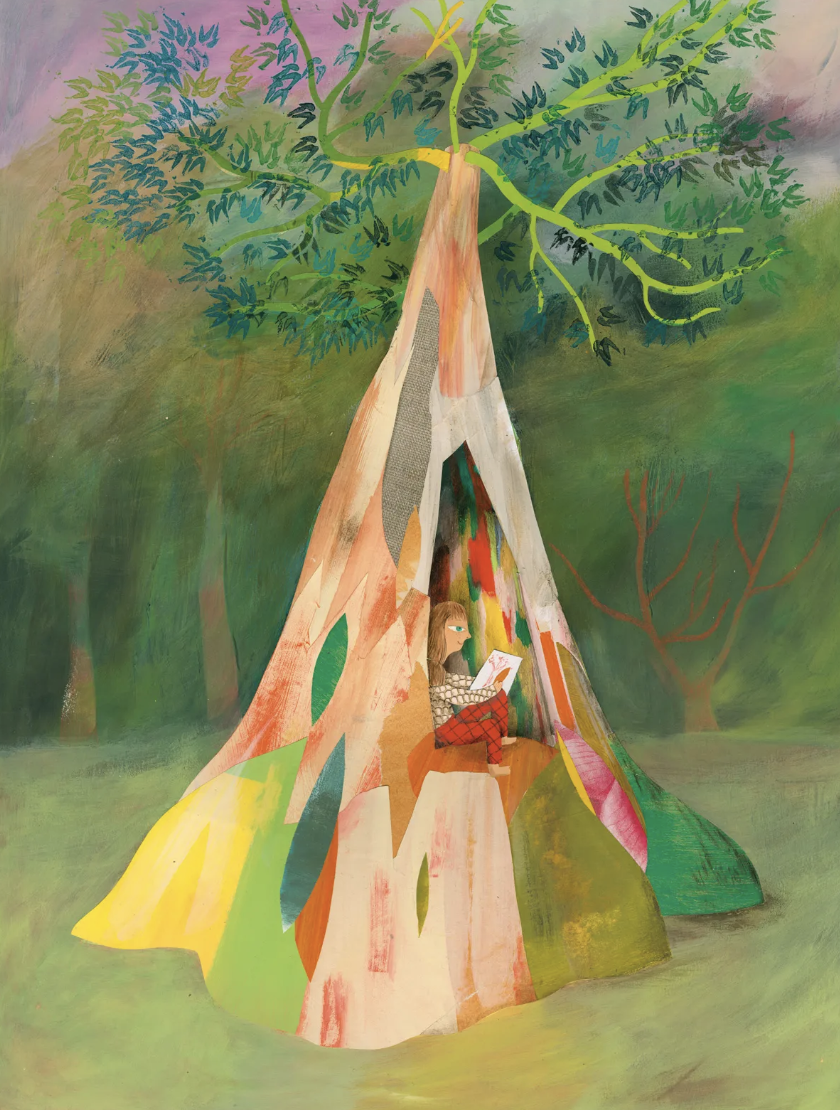
Rainbow Tree (Mindanao gum tree), Cécile Gambini, from book—Strange Trees
Do the humanities create “knowledge”?
It’s a question I have been thinking about after encountering a book by Chris Haufe, a philosopher Joanie recently studied in one of her classes.
It is a questions that sits at the center of an ongoing debate about the relationship between the arts and sciences—between what can me measured and what must be experienced.
In thinking about this issue, I have come to a conclusion that feels, at least to me, definitive. Unequivocally, the humanities—and the arts they foster—are not simply a source of knowledge. They are, in many ways, the origin of the search for it.
Or at the very least, the place where that search begins.
In the process of becoming a “writer,” I have found myself reading more, both in quantity and (I hope) in quality (by my own standards).
I have found it has made me read differently.
Let me explain.
I now concentrate on the text, its manner of delivery, and the reasons why the writer may have chosen to write in the first place.
In the process, I have found my writing beginning to “communicate” with the texts. Phrases, whole sentences, and the ideas behind them imprint themselves and insist on being analyzed and contemplated.
Within that process, It made me think again of the question, “How does one become a writer?”
Which brought up a familiar piece of advice: “Write what you know.”
That seems to imply very strongly that one should rely on “knowledge” as the basis for beginning.
But… it may only start the process and mechanics. One may begin to learn whether they have the tools and the intelligence, but the true art of writing—and the continuing inspiration to write—is in the discovery of what you do not know.
Allow me to throw out a few phrases that have recently stuck with me from the world of literature:
“Fast is slow and slow is smooth.”
“Mind is memory.”
A rediscovery:
“Hope springs eternal.”
“There are no words, but there are only words.”
These are not ideas that sprang from scientific “truths.”
They do not explicitly “explain” themselves, and they cannot be “proven.”
They require examination and contemplation to decide whether they are helpful in the process of living well—or understanding what life is all about.
But in this process of thinking about them, are they not useful in the very pondering of what we actually “know”?
Spend a little time rolling them around in your mind.
One comes from a marvelous work of fiction; one from a work about the nature of “consciousness”; another from a very significant work of poetry; and the last from an unknown source.
The essence and idea for each resides in the humanities.
I have the significant feeling that a great writer could weave a masterpiece around these few short phrases—maybe a novel, maybe a philosophical treatise, a love poem, or even (gasp!) a scientific breakthrough.
We could spend a weeklong retreat exploring the very human thoughts and feelings that they bring to mind.
Even I, only just learning to write, might find an essay or two—not that they would “prove” anything.
So where does that leave us… you?
It has inspired me to begin offering you, my readers, some suggestions for groups of books (reading lists) that center around a chosen theme.
I would suggest that they could serve a number of purposes:
– a list that one could simply dive in and out of
– a yearlong voyage of discovery
– or even an in-house book group for shared discussion
The possibilities are endless, and the potential rewards are great.
A Reading List:
Earth, Time, and Discovery
Just allow me to say that I cannot recommend these works more highly.
This collection comes from a group of writers who became acclaimed experts in their fields. They studied, in various ways, what can be called “Earth Science.”
But these works were not written for professional colleagues; rather, they were written to tell the rest of us what they did—and what they have come to “know” through a lifetime of work (rather like memoirs).
Reading almost any seriously created work of literature is a worthy venture.
But my continuing joy in literature is finding books that belong to a stream of discovery.
These books follow the story of how this earth came into existence, how it has changed over the eons, and what its major challenges are today.
The list:
– The Immense Journey — Loren Eiseley
– Braiding Sweetgrass — Robin Wall Kimmerer
– Finding the Mother Tree — Suzanne Simard
– Turning to Stone — Marcia Bjornerud
– The Invention of Nature: Alexander von Humboldt’s New World — Andrea Wulf
If you choose to work through these authors, it may feel as if you have earned a “master’s” degree in natural history.
Footnote
Eiseley — anthropologist turned naturalist (and somewhat “mystical”)
Kimmerer — biologist, naturalist, and advocate for Native ways (member of the Potawatomi people)
Simard — forestry biologist
Bjornerud — geologist
Wulf — historian and science writer
If nothing else, consider reading Eiseley’s small book.
It just might tempt you to go further.
Coda:
I will end where I began.
I believe that the title is evocative and contains the “root” of this debate over where knowledge comes from.
The full title could have ended with “of good and evil”. I chose not to make it biblical.
Yet, is it not sobering to recall that one of our first references in literature that is universally known is that when we become “conscious”, we are told that we are going to have to choose between those two essential concepts? —that knowledge is revealed in the natural world.
I would suggest that it still is.