
Fundamental Re-visted
What we believe without question—and what it costs us
By Clay Hipp
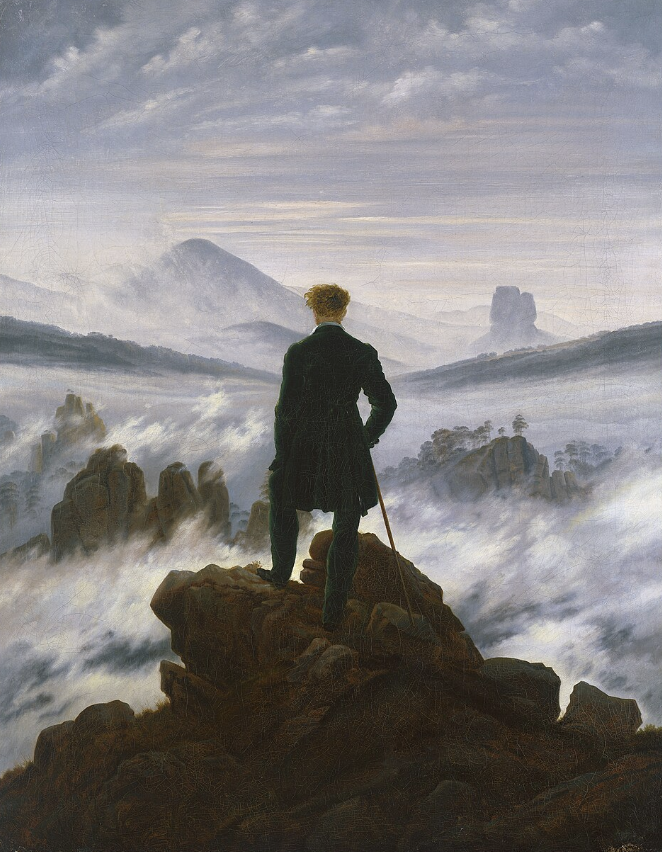
Wanderer Above A Sea of Fog, Caspar David Friedrich, 1818
I am guessing by now that you have gotten a sense of how much I care for words, choosing them as well as possible with a strong sense of precision.
The more I write, I tend to develop a special relationship with particular words. I find that I gravitate towards those that have complex meanings, that are fraught with subtlety, and sometimes even apparent contradictions.
For instance, some suggested synonyms for the title word: basic, essential, primary, elemental, rudimentary, underlying, cardinal, and key.
Is that helpful?
As we shall see, the word is not exactly “exact,” and all those choices are regularly used instead. At first, my feelings about it are positive—but is there a dark side?
As I have “matured,” certain words have taken on more and more importance, both in my writing but also in the much more expansive world of my thinking about a range of what I would call “life issues.”
Fundamental belief is one such example—not in any way meant to be taken as a statement about theology. I have a few friends with whom I have substantial issues with respect to our personal faiths. My approach has continued to evolve from my childhood, growing up in a traditional small town in which everyone was some flavor of Protestant Christianity (there was one Jewish family and one Catholic—they each had to drive 15 miles or so to a place of worship).
I have wandered around many variations on the theme. My current strong, unwavering philosophy is that everyone should be free to choose whatever path to “salvation” they find worthy.
But as you probably know, if you have wrestled with it at all, some very fine folks take the position that their own faith leads to “fundamental” truth, which seems to compel a proactive defense of these beliefs against modernism—and a need to persuade others to adopt it for themselves.
In other words, I respect their freedom to choose—but not their unwillingness to extend the same to others.
The part that offends my sensibility is that one approach is inclusive, and the other exclusive.
So, to my true purpose for writing here.
I have also encountered a form of fundamentalism in my professional teaching life. But here the focus is much more than “professional.” It is about something I have touched on periodically. Now, I will attempt to counter it head-on. I do not do it lightly.
Bluntly, a particular brand of fundamentalism is at the very heart of our current national, democratic, Constitutional dilemma.
The political environment got us here, but this is not about “politics as usual.” Rather, quite literally, we are here because of a fierce brand of economic, financial fundamentalism.
We all probably are familiar with the name Adam Smith. He is known as the father of so-called “free market” economics (if one does the due diligence to study his writings, they will find that today’s idea of the phrase is, in essence, a distillation of a very complex philosophy—he was a moral philosopher first, not an economist).
Along the way, a series of economists took a single idea to heart. To paraphrase:
“Adam Smith's famous phrase about free markets is the ‘invisible hand.’ He used this metaphor to explain how self-interested individuals, by pursuing their own gain, unknowingly promote the overall good of society, efficiently regulating production and resource distribution without government intervention.”
Take a moment to contemplate that.
Though it may appeal to any one of us individually (in this time and place), it is not a fundamental truth. Smith was writing during the eighteenth century in Scotland. At the time, his country was moving away from the feudal system and just beginning to leave farming, evolving into manufacturing and commercialism. The magical phrase was written totally in that context.
Over time, generations of “economists” adopted and taught through this lens. Others rejected it because of their own work and eventually engaged in vigorous debate about its efficacy in building functional economies.
With respect to the “markets” he was referring to, all buyers and sellers were small and lacked market power.
A single economist literally put this free market gospel into play.
Milton Friedman, a professor at the University of Chicago, wrote a piece in the New York Times that took the market by storm—converting business, educators, and the public to this “simple” proclamation.
Here is my summary:
“Milton Friedman’s 1970 essay, The Social Responsibility of Business Is to Increase Its Profits, published in The New York Times Magazine, argued that a corporation's sole responsibility is to maximize shareholder value while adhering to law and ethical custom. He described corporate social responsibility (CSR) as ‘pure and unadulterated socialism’ and argued that managers spending stakeholder money on social causes act as ‘unwitting puppets’ of anti-capitalist forces.”
The following thirty years saw a major move to do away with the regulatory economy created by Franklin Delano Roosevelt’s “New Deal” after World War II.
In 2010, the U.S. Supreme Court issued a ruling that affirmed the idea that corporations were individuals whose rights of “free speech” were protected by the First Amendment—and that money was a form of speech.
Six years later, a presidential election was heavily influenced by unlimited amounts of money that flowed into campaigns.
What does this have to do with fundamentalism?
The tale that I have just told leads me to believe that at least two forms of fundamentalism—probably three—are responsible for our catastrophic and extremely precarious erosion of our Constitutional principles, our democratic republic, and the American experiment that sought independence and freedom from oppression.
Enough already.
What do I see as the fundamentalist forces at play?
Today’s markets were crafted by a single idea that caused a revolutionary shift of managerial emphasis—from responsible care for employees, customer satisfaction, and community involvement—to the sole concern for profit and the bottom line.
“Christian Nationalism” (not to be confused with “patriotism”) insists on belief in a single doctrine of spiritual truth, tending toward “theocracy” to the extent that a political figure might be seen as sent by God.
Extreme egotism can culminate in the belief that one is the center of all power, to the detriment of any care for others.
In other words:
Extreme pursuit of profits led to an imbalance of political power.
Fervent attachment to one religious truth by those who felt oppressed resulted in misplaced allegiance to a flawed leader.
And that “anointment” has created a world in chaos.
Fundamentalism: Turns out it is not “fundamental” at all.
It is, instead, a veil of ignorance behind which to hide.
It is not “thinking.”
It makes “clear” thinking unnecessary—we have one rule to guide every decision.
It has given us “vile” leadership under the guise of a “higher being.”
It has given us “free markets” that have become “conventional wisdom” in such a way that we can no longer listen to alternative ways of governing—or even true “being.”
Economists have been treated as prophets, offering a simple way (the invisible hand of the “market”) for all decision-making—both in our businesses and even in society (and to finance their doctrinal faith).
Nothing truly matters but the ever-evolving “bottom line” of profit and progress.
We truly do worship bigger and bigger piles of money—the love of which is deep and wide—both essential and fundamental.
For those with eyes, let them see—and repent.
Lie prostrate before the Constitution.
All forms of fundamentalism proceed from a common core—that is, to make complex decision-making simpler.
Their strategies are also similar and simple: convince and convert.
Convincing enough people means, for them, that more of us will be on the same page. Converting means that, because of the first goal, simplicity increases—greater conversion lessens the noise from dissenters and troublemakers.
Dissenters are marginalized, labeled a danger to whatever the now-common goal happens to be.
Fundamentalist religion claims a single deity or prophet.
Fundamentalist capitalism claims that a corporation has only one purpose: maximizing and protecting profit for its “owners.”
Those who are not believers will only hinder the effort to convert. Converts must be extreme believers. Any crack in their armor allows doubts to creep in, thereby undermining the ability to make simple decisions—slowing down the process toward accomplishing the “goal.”
Efficiency is hampered by people who ask questions, and (in the process) the effectiveness of our governmental oversight suffers.
After all, that is just me.
What might you say in return?