
A New Student
By Clay Hipp
Back to the classroom, back to the joy of it
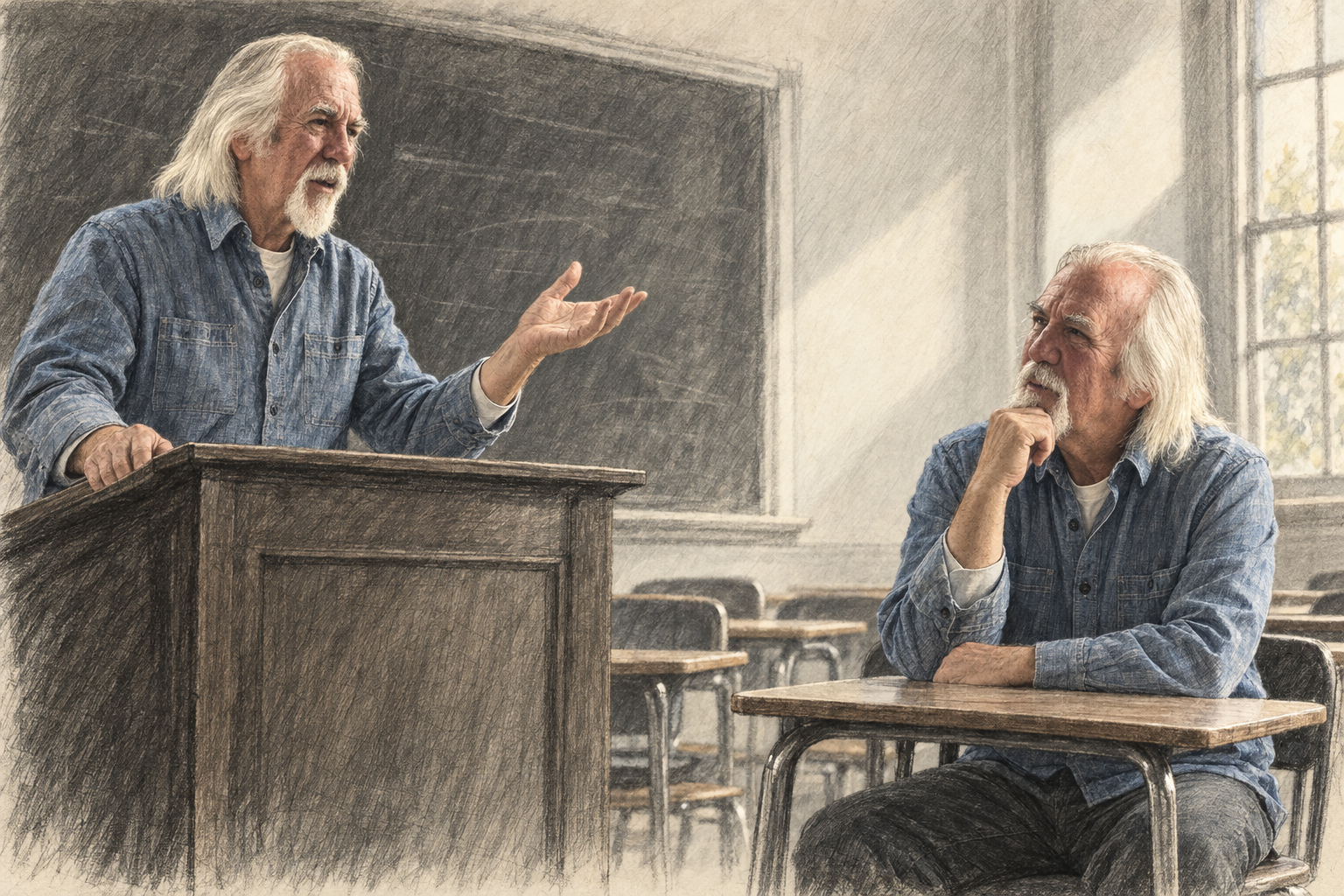
They say that you can't go home again. Maybe so—but one can always go back to school.
When I started my class this fall, I was surprised to find that one of the students stood out from the rest. Wake is largely a community of traditional students—young, energetic, typical—and he was clearly, as they say, "mature." My curiosity got the better of me, and I struck up a conversation with him after class. As it turned out, he already had a degree but had been away from school for a while and was going back part-time to take a few classes, with no particular goal in mind. I welcomed him and said, "Let me know if you need anything."
We talked from time to time, and I was impressed by his genuine love of knowledge and his curiosity. He seemed to have a wide range of interests. He was working as well as going to school, which limited our chances to talk much beyond the classroom, but his preparation and appropriate responses were welcomed. His wish not to stand out was plain, and he soon became simply one of the students, joining in before and after class as his time and energy allowed. The others seemed to like him.
Would that more of us had the luxury of going to school simply for the joy of learning.
Having only just returned to the classroom myself, I found that I had taken his lightness to heart, and I began to relax and to have a little fun of my own. At first I had taken the task much too seriously, and I was suffering some anxiety about how I was doing my "job." Then one day I woke up and realized that the "work" was truly interfering with my ability to experience teaching as a kind of "play." I had always been confident that my professional "knowledge" could carry me through—that I could turn it into a form of storytelling. So I resolved to make the classes as accessible as I could, without giving up my duty to lead the students where they had never gone before—and to do the same for myself, if I could.
Each week grew a little more relaxed as I settled into my preferred, modified "Socratic" style, and our exchanges and discussions grew less formal. As we approached mid-semester, and the issues grew deeper and called for greater analysis, I thought I could feel a new level of trust and confidence in the larger group. I was sensing that perhaps we were proceeding more like fellow students. It felt good, and it made me more confident as I tried to reinvent the class I had taught for so long. Much had changed in the legal environment in eight years, and I was beginning to feel like a translator of sorts. Because of the esoteric nature of the subject, we had to find a way of speaking that the others could begin to understand.
I was, in truth, a student myself. What a small—but significant—revelation.
Thanks for reading my little story. I am guessing that the more curious among you—you know who you are—are already saying, "That's all?" What about the fellow? Where did he go to school? What was his major? Do you think he'll make an "A"?
Well, for now I can tell you that he has multiple degrees, and yes, I believe he will—though I don't think it will matter much to him. He seems to be a generalist, interested in most everything. He is just at that point in life where he feels a bit in transition, ready for a change. To what? That, I think, is exactly the point. He has more questions than answers. He is only just beginning to "major" in life.
In truth, he is just a metaphor—and my alter ego.