
A Still Small Voice
By Clay Hipp
A song remembered, a question carried forward
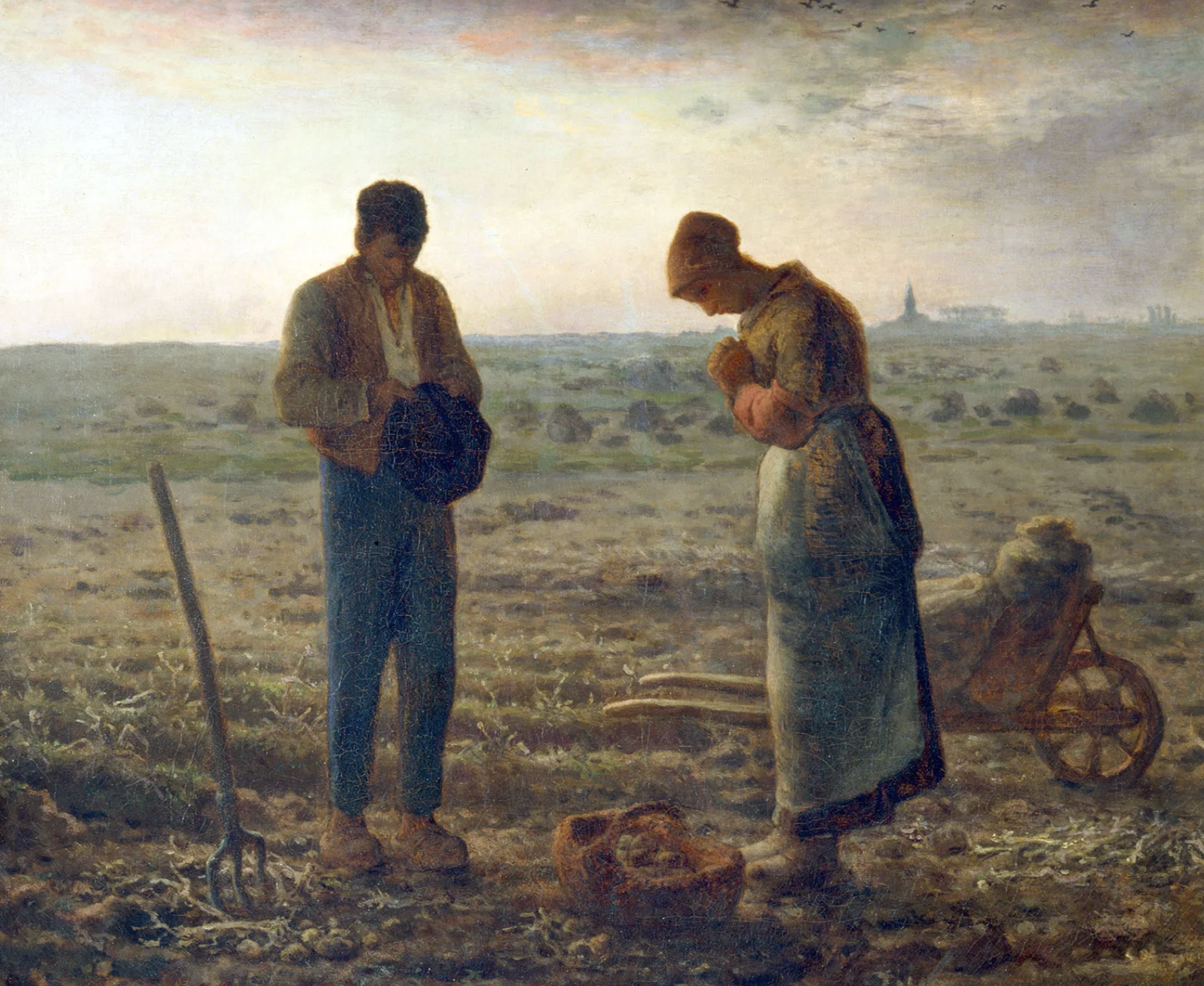
The Angelus, 1857–1859 — Jean-François Millet, French
Almost immediately after posting Sunday's Journal offering, this song came to mind. It was easy to know why. In fact, I think my very own still small voice gave it to me. (That is what we mean, isn't it, when we say that something "came to mind.")
Bob Franke was a songwriter who came through town back when we hosted a music series called Fiddle and Bow. He had an intriguing voice and a real gift for writing, and this is one of his most memorable offerings.
I listened to it again the other night, as though for the first time, and pondered the words for a good long while — remembering hearing it live, wondering just what to make of it. I was not exactly in my most "religious" period back then, but the idea of a still small voice was awfully appealing.
Now my contemplative self kicked in, and I found myself wondering what Franke meant when he wrote it. Let's read the lyrics together and try to figure out what they might say to you.
“In a still small voice in the middle of the night
Brother Martin heard the simple truth
And he followed its pleading though it led to a crossroads
Parting in the days of my youth
From the heart of my city came a single scream
And I heard it through all the white noise
And the papers told me that they’d killed the dream
But they never killed the still small voice”
In the 1960s, Martin Luther King heard that voice and led people peacefully down a road that seemed to be opening toward a better place — a better American reality, or at least the possibility of a peaceful coexistence. His dream ended in an act of hate and violence. Some have suggested the issue was bigger than race, that he was killed because he was about to speak out against the war in Vietnam. That does not seem so far-fetched. Certainly those in high places pushing the President were aware that Dr. King had influenced him strongly toward the Civil Rights Act. Might he yet have spoken to the President's better angel? We will never know. But we do know what came next. Another assassination changed the whole shape of the Democratic nomination. The election gave us a nominee who lost, in the end, to a man who would later be threatened with impeachment and resign.
What if King had lived, and Vietnam had never happened? Why are these small voices given so little attention, and granted so little power?
“All the lies come at you in a million ways
Some you hear and some you tell yourself
And they say that virtue is a pile of gold
And that weapons are a nation’s wealth
But when kings stand naked in their ugly schemes
Will the poor of this world rejoice?
Will they sell their children down a bloody stream?
Or will they listen to a still small voice?
That same era helped usher in the deregulation of the marketplace. Whether one praised that philosophy or not, time has shown us how the idea — and its manifestation — has led, and still is leading, to a radical change in the way we govern ourselves.
“Now the one-eyed bandit in your living room,
Will convince you that you have no time.
It will swear to take you on your one free ride,
While it’s looking for your last dime.
But the light of heaven is a simple gift,
You can see it when you make that choice.
It will shine like riches in your inmost heart,
But it will speak in a still small voice.”
We must each, now, begin to decide our future. The choice is ours to make. Do we choose yet another era of letting the marketplace make our choices for us — or can each of us listen to whatever our still small voice, however we define it, tells us is the proper path for the country as a whole, divided or unified? Is a personal "pile of gold" the answer? Are power and individuality to rule us — or some better reality? What does your inner music tell you?
“Oh, the sky will open when the trumpet sounds,
And the thunder will shake these walls,
And these stones so silent as they ring us ‘round,
They will shatter when they hear that call,
And these chains will clatter when they hit the ground,
And the people “make a joyful noise”,
It will be in a still small voice.”
M.L. King's was a prophetic voice. So, I tend to think, was Bob Franke's. It seems to me these times could use a prophetic voice — to inspire and to lead us, both at once. But from whence will that voice, or those voices, come? What did the Old Testament prophets do — predict the future, or point out our faults and tell us what would likely happen if we did not change our ways? I think the latter.
The trouble is that we have adopted a political system in which we ourselves choose our leaders. Is that system likely to produce prophetic voices? Dr. King was silenced, possibly for his politics. Bernie Sanders — whatever you make of his views, which the opposition calls "socialist" — saw his own party work against his campaign, almost certainly because the leadership judged him "unelectable," and chose another candidate, who then lost to someone who has transformed the political landscape, perhaps forever.
Is there a prophetic voice out there somewhere, crying in the wilderness? If you hear it, listen carefully.
The still small voice has no single source.
Some think it is simply within us.
My hope is that we can find the answer and sing together. Our personal faith journeys seek, and find. And perhaps, if enough of us listen, our collective conscience will carry the message to everyone.
Personally, mine is saying:
“And these chains will clatter when they hit the ground
And the people make a joyful noise”