
The Miracle of Mind and Memory
By Clay Hipp
The mystery of consciousness, the sacredness of being alive
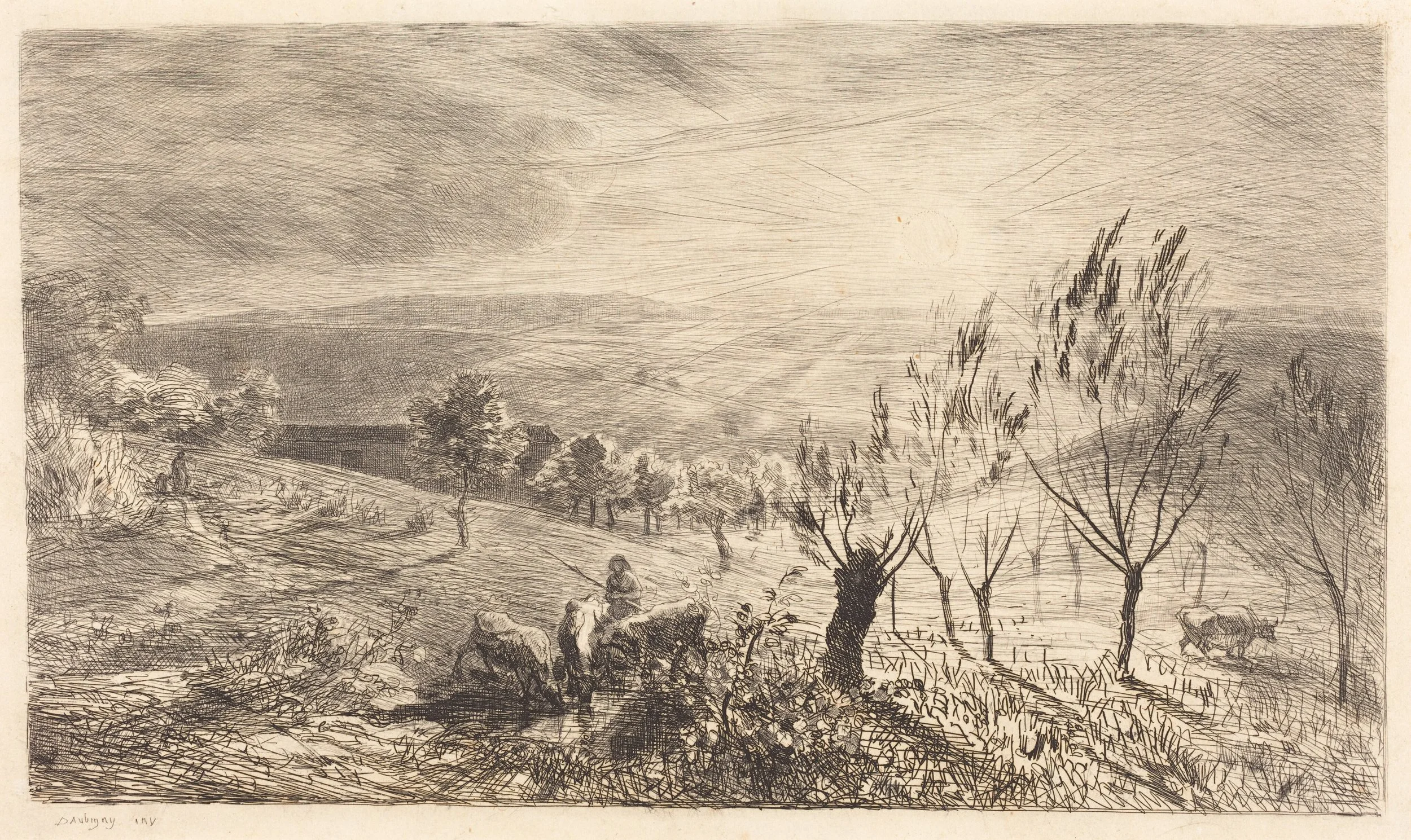
Sunrise (Le Lever du soleil), 1850—Charles-François Daubigny, French
"Mind Is Memory.” —Unknown
"Life Is a Miracle." —Wendell Berry
What is one supposed to make of these two statements? For me, one seems to lead to the other—or is simply a reflection of the other.
To deal with Berry’s claim first: to believe in miracles creates, for me, yet another step. Now I must contemplate the mystery of it all.
My experience with the mystery of life itself is that I have reached some very personal conclusions. Three things feel “sacred”: the land, the people, and music. But there is also an overarching sense of sacredness, and that is the gift of consciousness.
I explore it through meditation, contemplation, or mindfulness. I tend to think that these are all simply words attempting to describe one’s search for answers about the meaning of life itself.
We seek to experience something of the miracle.
Whatever one calls this special time of very personal silence is fine with me. I have come to prefer "mindfulness" because it hints at becoming more conscious of our existence and of the big questions.
My best time is the hour between five and six because my mind is more susceptible to being still and listening. Over time, my most sacred moment has become "first light," when dawn is just breaking and the first bird sings to announce its presence—and a brand-new day.
It is the awareness of living that is of highest importance to me.
One of our finest practitioners and teachers of the therapeutic value of mindfulness, Jon Kabat-Zinn, suggests a process he calls a "full-body scan." One sits for at least thirty minutes in slow, mindful, intentional concentration on the body.
I have found it most helpful in two ways: first, simply identifying any trouble spots and, second, becoming more aware that we are indeed "alive."
Kabat-Zinn's book, Full Catastrophe Living, is huge but very fine.
Consciousness is a very active area of research these days, attracting some of our finest scientists, who offer various and conflicting theories about what consciousness is and what its "source" might be.
If this topic interests you and, like me, you have a hard time understanding primary sources, read the very fine exploration and distillation of current research offered by Michael Pollan in A World Appears: A Journey into Consciousness.
If one needs a huge point to ponder, a great friend recently said to us:
"The whole world is conscious."
He meant all of our physical existence—including plants, small insects, and even stone.
Berry's statement is the title of a very small book in which he challenges a conclusive position taken by one of our great biologists, E. O. Wilson.
Wilson is famous for his work in a field known as sociobiology. Simply stated, he posits that all human behavior can be explained by our evolution as we became "human animals." He even states that there is no such thing as true altruism. We may seem to act unselfishly, but we are always seeking personal benefit.
In his book, Berry argues that life's mysteries cannot be fully explained by data and that treating science as a replacement for the humanities and religion leaves us morally and spiritually adrift.
Berry is quick to tell us that he has not read Wilson's book fully, but that he simply could not let that concept of humanity stand unchallenged.
Almost everything I contemplate these days has to do with trying to appreciate, honor, and value what I consider sacred.
If eight decades might teach us something, it is that we simply do not know what comes next. We must cherish what we have and the gifts we have been given, and live for now without worrying too much about what happens when it ends.
A great Vietnamese monk named Thich Nhat Hanh wrote widely about the universal value of contemplation and the practice of living it in everything we do. He considered something as simple as walking to be a form of meditation. One of his books is entitled Peace Is Every Step.
In one of his many works, he tells a wonderful story—probably apocryphal—about an old monk teaching a small group of budding young monks.
To get things going, he asks the class a question:
"What is the lifespan of a human being?"
After a period of silence, one ventures:
"A hundred years?"
He silently notes the response and turns back to the class. Another suggests:
"One day?"
He receives it in the same way.
Finally, a very small voice says:
"Master, one breath?"
The old monk says:
"That is correct."
And then he moves back to the lesson.
Humbling—but the point is made and inescapable.
If you choose to pursue Kabat-Zinn's body scan—I have found it truly enlightening, and a grand way to enter a state of mindfulness without having to "practice, practice, practice" that some teachers seem to require—do one thing for me.
Begin by breathing deeply and gently while pretending that the breath goes straight to the lungs and heart. Be intent on the expansion of the lungs and the slow, methodical beat of the heart muscle.
Next, feel the flow of oxygen to the brain and your open mind, and then the clearing of some of the distracting thoughts.
I have found it curiously helpful to pretend that I am breathing through the very top of my head.
But most of all:
Take note of the evidence that you are alive.