
A Summer Syllabus for the Soul
By Clay Hipp
Find your way somewhere without ever leaving the porch
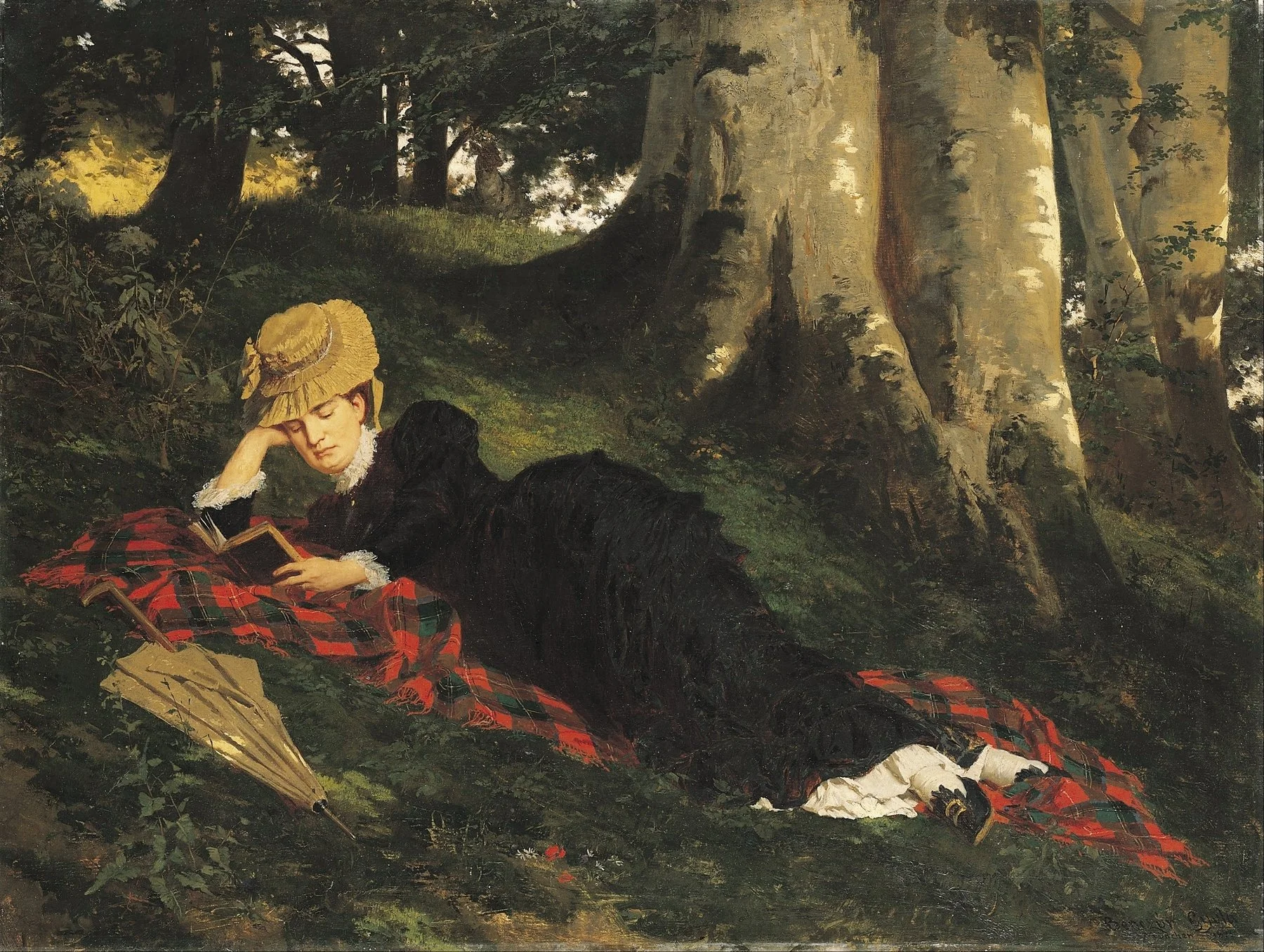
Woman Reading in a Forest, 1875, Gyula Benczúr, Hungarian Painter
"There is treasure everywhere." — Calvin and Hobbes
I find my treasures in song and all music, poetry and literature, time at the table communing with friends and family, and, of course, the beauty of the natural world around us.
As I look forward to easing my mind to be able to celebrate this huge moment in our time as a union, I ask, “What will suffice”? More and more music, for sure. I just looked at the scheduled performances at the Brevard Music Center; I felt almost compelled to sell everything and move somewhere nearby. It is just far enough away from here to make us think twice about going down. The riches that we forgo each summer almost make me cry. There are a few performances that I pledged to myself not to miss….
But, there is an easier way of going somewhere: on the porch in the early morning and evening, or air conditioning if necessary…reading something worthy. Since you have not asked, I will tell you anyway the sources that I am consulting this season. Mostly classic fiction with some fine nonfiction writers as well. Here is a tentative list of authors and their works that I recommend highly:
Fiction — The West
Willa Cather
Any of her novels is a worthy read and getaway. A few that you may or may not know:
—Death Comes to the Archbishop. Set in colonial New Mexico, it introduces us to attempts to take the “gospel” to the pioneers, the Spanish, and the natives. It also gives us a look at the hardships and the difficulties associated with clashing cultures and of merely surviving in a difficult climate, but also the beauty of what would become known as the “Land of Enchantment” — did I mention the sunsets?
—Song of the Lark. “In this powerful portrait of the self-making of an artist, Willa Cather created one of her most extraordinary heroines. Thea Kronberg, a minister's daughter in a provincial Colorado town, seems destined from childhood for a place in the wider world. But as her path to the world stage leads her ever farther from the humble town she can't forget and from the man she can't afford to love, Thea learns that her exceptional musical talent and fierce ambition are not enough.” — Vintage Classics
—One of Ours. “Claude Wheeler's journey from the Great Plains to the battles of World War I are chronicled in Willa Cather's Pulitzer Prize-winning novel. The sensitive, aspiring protagonist of this beautifully modulated novel, resembles the youngest son of a peculiarly American fairy tale. His fortune is ready-made for him, but he refuses to settle for it.”
Zane Grey
I grew up thinking that he only wrote “cowboy books.” Boy, was I wrong, and I am so glad to have found him now. Yes, there are “cowboys,” but they ride herd on cattle and protect them from harm and theft. He writes about the clash of missionaries and “heathens” and the effect on the relationships men and women, and can spin a worthy love story. Oh yeah, he also writes stories that illustrate his love of baseball at the beginning of the 20th century. He was a prolific writer. One might start with Riders of the Purple Sage and a sequel. A very special novel is named The Vanishing American, which was inspired by the life of the great Jim Thorpe.
His writing is more than storytelling. His prose is unbelievably beautiful and paints word pictures of the desert Southwest.
Wallace Stegner
To my mind, one of our greatest writers, who is known for his chronicles of the West. He was a professor of literature and an environmentalist. His writing program at Stanford was attended by Wendell Berry, Ken Kesey, and many others…. Consider reading:
Angle of Repose, Big Rock Candy Mountain, Crossing to Safety, and a nonfiction masterpiece, Beyond the Hundredth Meridian, a biography of John Wesley Powell, the first non-native to travel through the Grand Canyon on the Colorado River.
A.B. Guthrie
The Big Sky and The Way West. Guthrie was literate, but his research was clear and his care for our grand history impressive. I recommend him to those who like to explore places through stirring, adventurous storytelling.
Fiction — Contemporary
Wendell Berry
A Place on Earth, Jayber Crow, The Memory of Old Jack. All of us must get to know Berry’s work—there is also poetry and essays about sustainable farming. Jayber Crow is one of the finest novels in my experience. His story as a barber in a small town in Kentucky has it all and is a major component of a continuing story about the mythical village of Port William that begins with A Place on Earth through his novels and short stories.
Ursula Le Guin
The Left Hand of Darkness, The Dispossessed, and the series, Tales from Earthsea. A writer of “future history” along with some fantasy. Le Guin unfolds the story of civilizations to come. It teaches about our present through speculative thinking about the future.
Marilynne Robinson
Gilead and four sequels tell the story of Reverend John Ames. It comprises the fictional autobiography of John Ames, an elderly Congregationalist pastor in the small, secluded town of Gilead, Iowa, who knows that he is dying of a heart condition. At the beginning of the book, the date is established as 1956. Ames explains that he is writing an account of his life for his seven-year-old son, who will have few memories of him. Ames indicates he was born in 1880. He said that he was seventy-six years old at the time of writing.
Richard Powers
The Overstory, Bewilderment, Playground. Powers has the finest mind among our present writers. Headed at one time towards astrophysics, he can no longer be contained. Please read The Overstory and get his big picture.
Mark Helprin
A Winter’s Tale, A Soldier of the Great War, Freddy and Fredericka, The Oceans and the Stars. Quite simply unmatchable prose and storytelling. Please consider Soldier; you will never experience literature in the same way again.
Nonfiction
And finally, the story of our precious world through the eyes and minds of one indescribable man and four miraculous women:
—Loren Eiseley, The Immense Journey, anthropologist and much more.
—Andrea Wulf, The Invention of Nature, nature writer.
—Marcia Bjornerud, Turning to Stone, geologist.
—Suzanne Simard, Finding the Mother Tree, forestry, biology.
—Robin Wall Kimmerer, Braiding Sweetgrass, biologist, Native American ancestry.
I would adore teaching these as a course for the curious.
So there it is — my summer syllabus, offered freely and without apology. Pull up a chair. Pour something cold. Let the porch do its work. The treasure, as Calvin always knew, is everywhere. You need only open the cover.