
Baseball: The Joy of the Game
Finding grace in the unhurried, one run at a time
By Clay Hipp
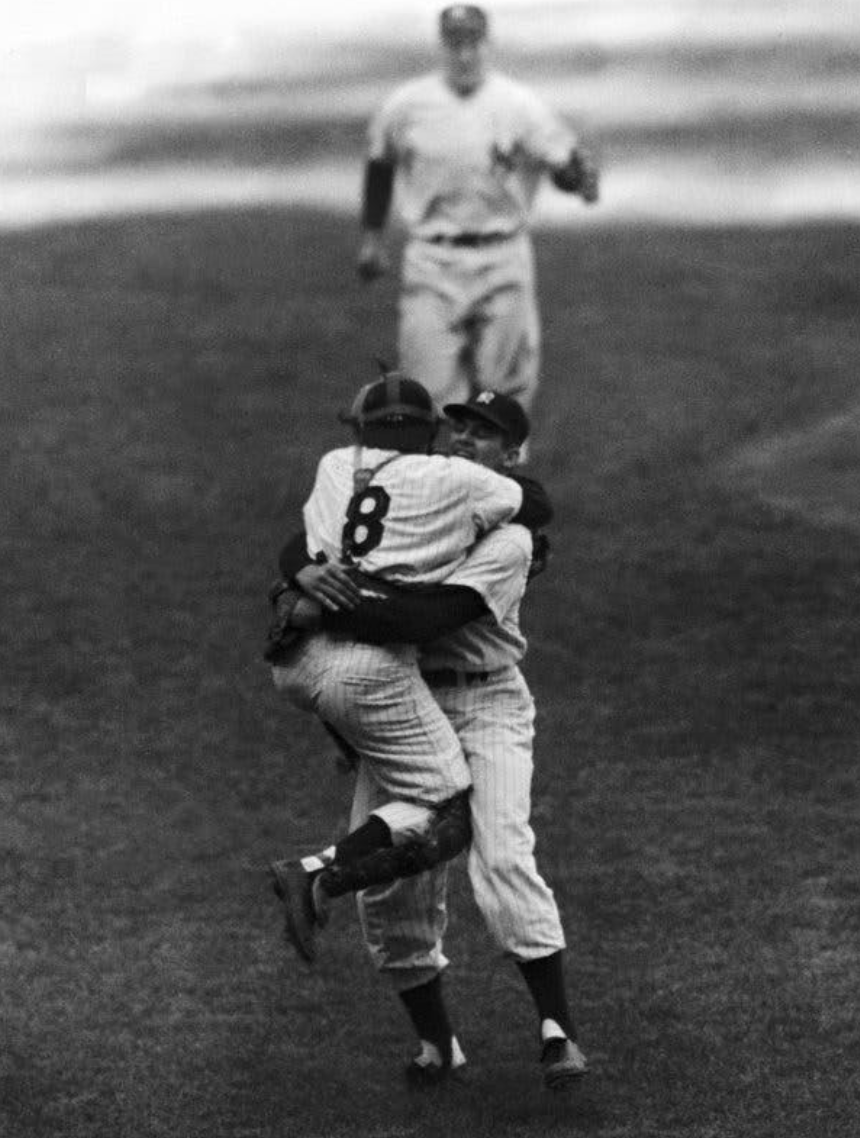
Yogi Berra and Don Larson, 1956
“The one constant through all the years, Ray, has been baseball. America has rolled by like an army of steamrollers. It’s been erased like a blackboard, rebuilt, and erased again. But baseball has marked the time.”
Dear Readers,
Baseball season is here.
And with it…a realization.
I don’t experience it with the joy I used to feel.
Some teams get richer, some poorer (there seems to be a correlation).
Something about the game feels different now.
And yet—I can’t quite let it go.
Because baseball has been a steady thread running through my life.
Let me tell you why…
I have played it from sandlot, through Little and Pony League, high school, and college.
I was a Yankee fan in the fifties (my Dad’s team), a Cubs fan because I was a shortstop—and so was Ernie Banks—until 1966, when the Braves came to Atlanta.
They were awful.
But Henry Aaron was chasing Babe Ruth’s all-time home run record.
They developed a few stars and were the Southern team, so I became attached.
Eventually, they won a World Series and were a fixture at the top of the National League East for two decades.
(Chipper Jones and Greg Maddux!)
But I played—and consequently understood how difficult it was.
I never griped about how “slow” it is.
It is supposed to be.
No time clock.
And it is “never over ‘til it is over.”
Any deficit is theoretically possible to overcome in the bottom of the ninth.
Hope springs eternal in the human psyche.
It is different from any other physical game.
Each of the nine positions on the field is important—even the proverbial “right fielder,” who was almost always the smallest, least skilled, and chosen last when someone picked sides.
But it is certainly true to point to the pitcher and batter as the most crucial pieces of the puzzle.
The pitcher tries to fool the batter about what is coming next—and the batter must try to predict.
(It is much harder to hit pitches that move—curves are not an optical illusion—or when the pitcher changes speeds. A fine fastball can arrive at the plate at over 90 miles an hour.)
Imagine a batter attempting to calculate all of those variables.
All that—and more.
It is a “team game,” but there are no huddles or scrums.
Each player is truly on his own.
A single crucial strikeout or error in the field can make one the hero—or the goat—of the day.
The boundaries (foul lines and fences) merely define the playing field.
What counts is reaching base safely and, hopefully, home plate—the only place where the score is affected.
One run at a time.
You can hit a home run, or coax a walk to first base and “steal” three more bases—still only one run.
I always liked that.
Both speed and power were admired. And even if you lacked each, being a good defensive player—of whatever size and strength—could save runs. Just as important to the final score.
Catchers behind the plate had to squat down all afternoon.
Center fielders ran long distances as fast as possible to track down batted balls.
Another lovely thing…
As the game unfolded, each play was watched, appreciated, and celebrated by eight other players.
If you have never seen a home plate celebration, you have missed a lot of joy.
I remember one eventful inning when a younger teammate leapt off the bench to meet me in glee as I finished off the third out. In other words, there are many versions of a “team” sport.
My little brother and I were five years apart—just enough distance that we didn’t quite grow up alongside one another. But baseball bridged that space and became one of our greatest shared joys. We had a very technical board game with which one could actually recreate a past season due to its statistical accuracy.
During the hot summer afternoons of 1962, we “played” the entire 1961 American League schedule—and kept score (as baseball nuts did) on a huge, accountant-like ledger. Remarkably, the same top teams prevailed. Including our beloved Yankees.
Mickey Mantle and Roger Maris were neck and neck in home runs until an injury slowed Mantle—and Maris won with 61, surpassing Babe Ruth. Mantle finished with 54. (He did win the highest batting average.)
I no longer watch very many games—live or online. But I do still look at the Braves box score from the previous day.
It is kind of cool.
Because as I was growing up, there was only one “game of the week,” televised on Saturday afternoon.
The rest of the time, I would get up, pick the paper up from the front lawn, and open to the sports section to check my team.
Prior to TV, there was a “Mutual Game of the Day” on the radio. When I got my first portable, I would sometimes sit in the shade of a big oak tree on hot summer afternoons—and fantasize about being in the bleachers at Yankee Stadium. In those seemingly simple days, it did not take much to make one happy.
Oh yeah…
Before my time, Ronald Reagan broadcast baseball games on the radio. He read from a “ticker tape” to announce the games as if he were there. I guess good actors have many skills. (But he did not try to mimic the crack of the bat.)
Pity.
“Those were the days, my friend, we thought they’d never end.”
In fairness (as an update), I should report that I became caught up in the World Series pairing this year. We have a good friend with a big screen TV (we have none of any size.)
He is still a sports fan. He and I agreed to watch the series together.
Low and behold, I even talked Joanie into watching it with us. (She has almost no history with any “guy thing” sporting events.)
Knowing that I truly cared for baseball, she relented—saying that she ought to get some fluency.
We watched together.
David and I have no love for the Dodgers. (They are the arch rivals of the Braves—and have the highest payroll in the majors.) So we became caught up in the significantly underdog Blue Jays—and were devastated when the seventh game went to the Dodgers. The consensus—even among Dodger fans—was that they were significantly outplayed by a group of unknown players who had little publicity.
Wait until next year…..
Consider this:
Baseball is a “slow” game. And I, for one, do not consider this a flaw.
If you regularly feel that we are all living at the speed of commercialism—and of monster trucks on our highways and byways—take a break this spring.
If you have a college or minor league team nearby, choose a beautiful day.
Clock out. Sit in the stands and watch the play.
The crack of the bat.
The long, over-the-shoulder catch.
They are magical.
Let it flow all around you.
Surrender.
You might just discover why it was, at one time…
the American game.
Postscript
If you would like a very fine American history lesson, consider watching Ken Burns’ documentary on Baseball.
It covers roughly the period 1860–1960.
It includes politics, capitalism, racism, human nature—and more.
Even if sport is not your thing, you will learn so much about the country we call home.