
Democracy: Shades of Gray
Washington warned us. Adams and Jefferson didn't listen. Are we finally ready to?
By Clay Hipp
Lately, I find myself wondering.
Is this the end, or a new beginning?
This is not the way it was supposed to be, and yet…….
it also feels almost inevitable.
George Washington in his farewell address warned us that two principles were essential:
He urged Americans to cherish national unity as the "main pillar" of their prosperity and liberty, warning against political factions and regionalism.
He advocated for an independent foreign policy, urging the nation to avoid permanent alliances and entangling political connections with foreign powers.
Is that ominous or not?
How could we not have taken to heart these sentiments from the "Father of Our Country"?
Yet immediately after he left office, Adams and Jefferson began an "internecine" war of factionalism. Do we not find ourselves in exactly the opposite place that Washington warned of, and, ironically, just like Adams and Jefferson?
The story is too complex to tell, but true patriots must research and study it. One will see that "party politics" were already in their infancy. The roots of this challenge to the great American experiment were already coming to a slow boil.
How many of us are aware of this prophetic story?
My guess has to be that the "founding brothers" were so caught up in holding things together and also having to keep a wary eye out for Great Britain and the crown, and the (still) loyal "Tories" amongst us, to be perfect protectors of our newly founded republic.
In other words, it is up to us to choose, and make, our own destiny.
What is your dream?
What are you willing to do to make it so?
An even bigger question—are we as a people willing to receive a long due history lesson about what our country was and has been?
It seems clear to this brand-new octogenarian that the teaching and learning of history, in general, has deteriorated so immensely that nothing short of an American commitment to civic education can turn our ignorance around.
In other words, we are living in a period of American intellectual darkness.
Is our current state of affairs not clearly obvious?
Where will the wisdom come from? Where are our "intellectual" leaders?
If you find this little rant a bit much, fine. But before you reject it out of hand, do me the favor of painting a different vision.
Are you content that we will exit this current difficulty unharmed and simply resume our comfortable lifestyle?
How does that work?
Our national governing institutions are strained. The Congress and the agencies that THEY/WE created out of necessity because of the complexities of modern life have been depleted of expertise and the ability to carry out their essential functions. The personnel remaining often serve narrow interests rather than the public good.
The "independent" freedom of press guaranteed by the First Amendment to the Constitution, for goodness' sake, has struggled to fulfill its essential role.
When truth becomes elusive, what is left?
I have found a tentative answer. I should be able to offer something after painting such a dire picture of where we are.
Did I say "reformation"? It must have been a slip of the tongue.
I meant a peaceful "revolution" which is a necessary pre-condition to replacing those powers that have torn down all of our sacred "principles".
It took a revolution to found this country. Do we have any true patriots equal to the task of reviving it?
In short, we might just need a "secular savior".
One must hope that there is a statesman or stateswoman to emerge and lead us forward. If not, we are on our own to find a way to survive.
So, I held this in my mind until an inspiration appeared. I re-read the Declaration and the Preamble to the Constitution. The words were familiar and we all (I hope) know some of the magic words. I tried, as I read, to "decipher" them anew.
Two phrases began to merge:
"Declaration of the Thirteen United States of America" (As it was originally titled and passed by the Continental Congress on July 4th, 1776)
"...that all Men are created equal… with certain unalienable Rights, that among these are Life, Liberty, and the Pursuit of Happiness"
Take note. Thirteen "united states" declared this and laid down principles upon which they would recognize individual worth.
THE FOUNDING INSIGHT
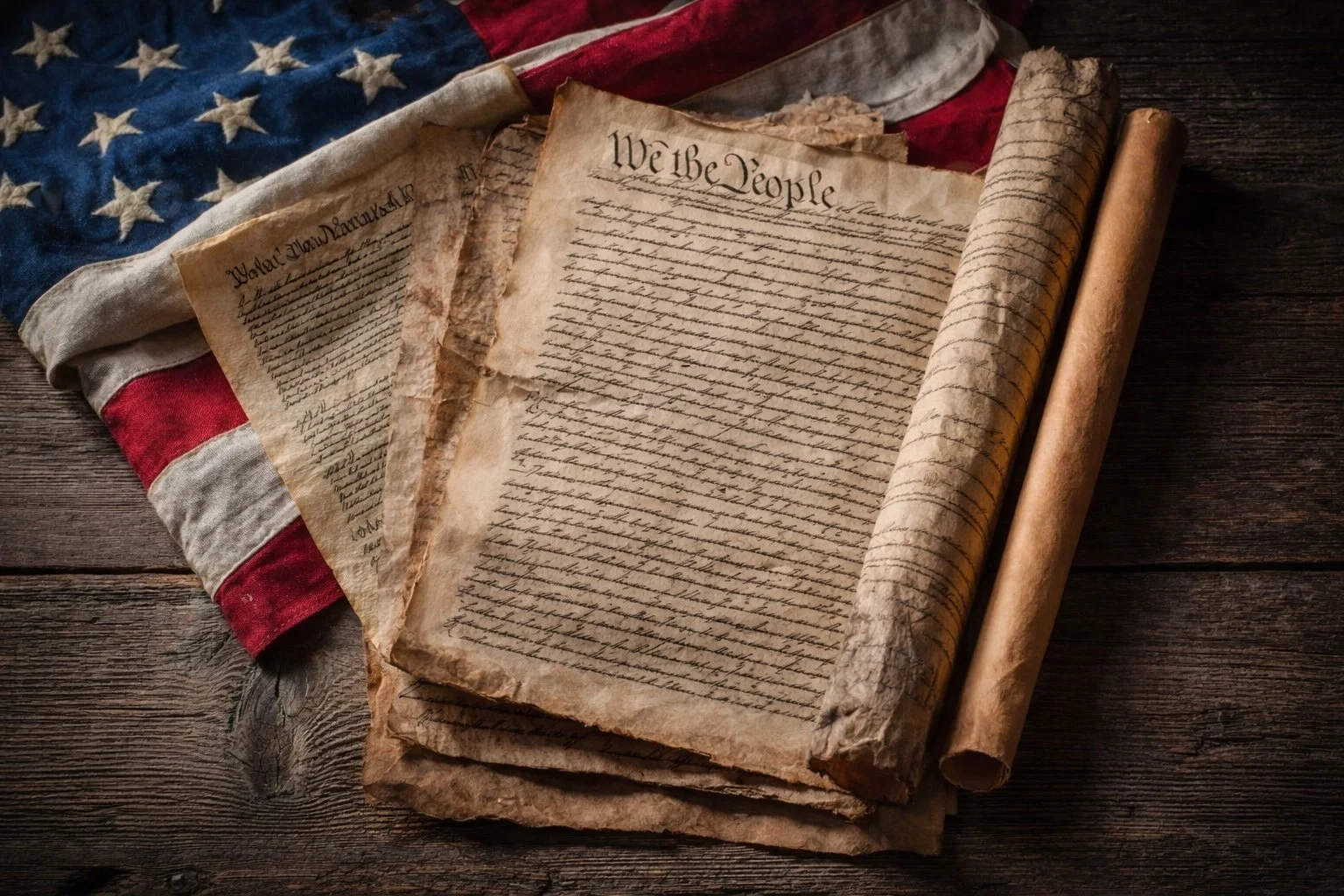
When the Constitution was ratified ("thirteen"!) years later it began "we the people… in order to establish a more perfect 'union'". From our very beginning the founders recognized that these very diverse colonies "needed" each other to achieve their common goal.
But, even then, they were strange "bedfellows" (if anything even less alike than we are now). Add the "freed" people seventy-five or so years later and, well, you can see where these documents, and the people who declared them, were bound.
I began to see that these words may not mean what we might have thought they meant.
Let me explain.
Return to George Washington's parting concerns. It seems, in the middle of our first decade, that when he referred to the need for "national unity", he was speaking about the sovereign states, not individual people. Why had I not seen this before?
Does that make it any less valuable for an average citizen to arrive at that insight?
But what might that mean for you and me mired in conflict abroad and terrible political disagreements here at home?
Let's think together.
The states were colonies, created for a variety of reasons. When they were brought together around a "common enemy", their "sole" purpose for declaring independence was achieving self-governance. Individually, they stood little chance against the military of the King. They chose to "cooperate" despite their previous significant differences.
They won.
Now what?
Were they truly a "nation"?
Clearly, no. It was simply an "idea" on which to build.
On the ground, we were still individualistic "pioneers" pursuing the opportunities for success and gain, and having a great love for "property", having been serfs and subjects (and in some cases "criminals"). We were of different heritage and religion and culture.
How could anyone, in retrospect, think that we could outlast and overcome our individuality?
Eventually, western expansion, and the quest for precious minerals and the availability of wide open spaces, led to yet another serious difficulty—we were not the only "Americans". When we encountered their own claims of a different kind of "sovereignty", we added yet another layer of complexity to the cauldron of humanity.
Do we begin to see?
Our current schism is a reflection of what we have always been, and who we have become, and suddenly our individual differences have overcome our idea of Union.
So, the question before us is whether we can return to the idea of "Federalism", shared "sovereignty of each state" among very different groups of people.
The founders recognized this from the beginning by giving the populations of each state power in Congress by direct choice of who would represent them in the House. At the same time, each "state" had the same number of Senators.
Are we capable of reconciling our differences by putting away our individual "preferences" through a different idea of Unity? That is letting each state through the political process, one person, one vote, reflect and define its priorities and have our destiny worked out in a true "original" Congressional process.
My suggestion?
The world is neither black nor white, but rather "shades of grey".
It is neither blue nor red.
I have the sense that at the heart of the matter most states are some shade of purple.
Let's band together—establish a "Deep Purple Coalition" (not to be confused with a "party"), but rather a huge uprising of voters who occupy the territory around the "center" of the population.
No left or right, blue or red, and no radical beliefs that they have all the answers.
Open minds and open hearts—people who have seen and experienced the worst possible outcome for democracy.
Legislators and fellow citizens who have forgotten how to do anything but call names and refuse to listen to the other side—even for the sake of the survival of our common dream.
Let's test the idea that we are "divided" by strong beliefs and preferences, but that we can discuss them, not as radically left or right, blue or red, but as "neighbors" who live and work together.
But only if the states themselves "re-unite" and re-declare:
"Declaration of the Thirteen United States of America"
We must not forget that we are all "purple" now.
Let's make Father Washington proud.