
Beauty Will Save the World
By Clay Hipp
A practice of attention, a wager on wonder
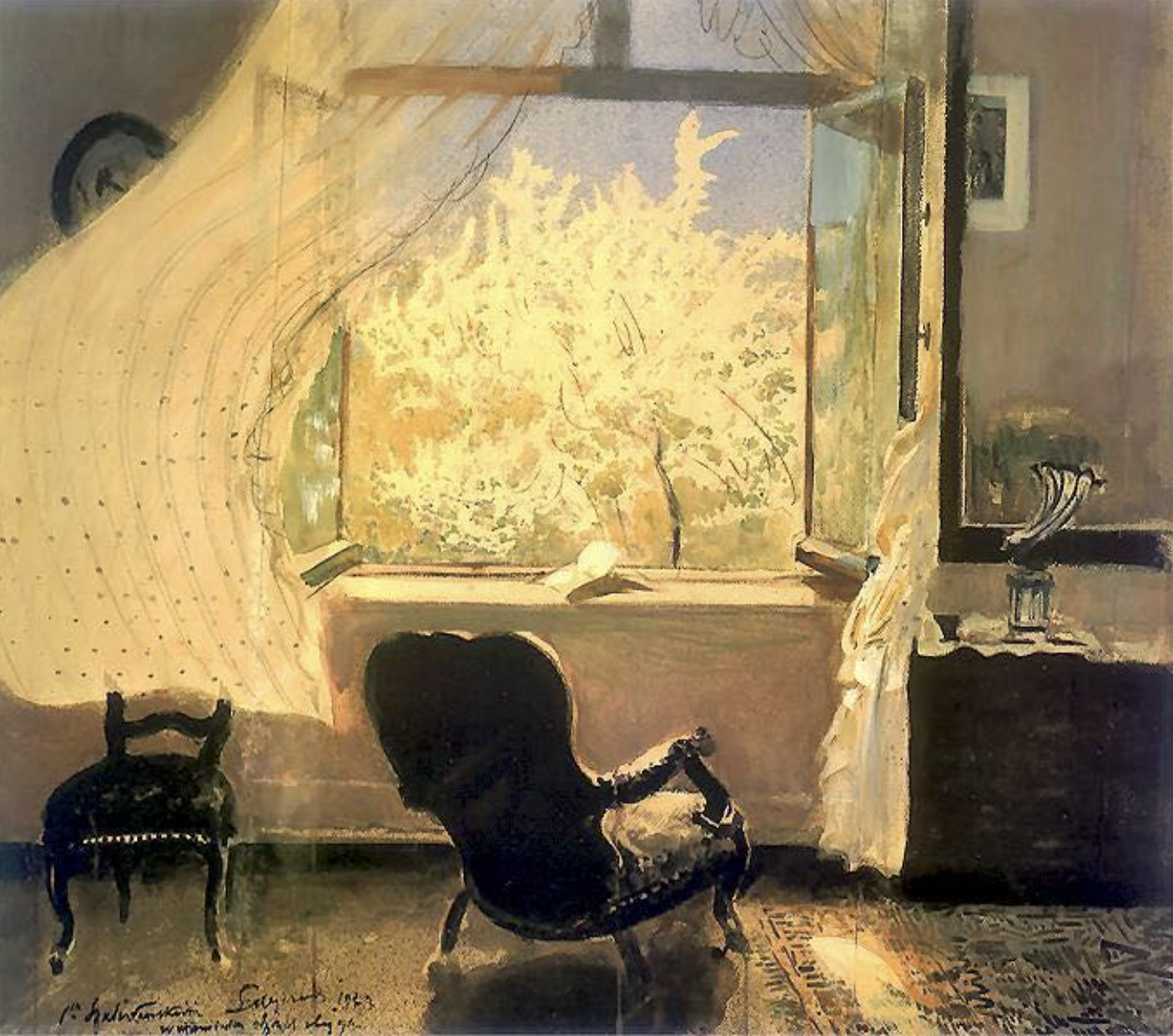
Spring in Gościeradz, 1933—Leon Wyczółkowski
An Aside
An open message to members of the Orlando Gatito Society
I have been in a particularly pensive mood this week. This is probably due to being betwixt and between—the middle of my first semester back at teaching, with the wonderful challenges I am working through, and the great anticipation of a week at the shore in our favorite oceanfront lodge.
The result, as far as the Journal and Words That Sing are concerned, is a strong desire to accomplish two things: to keep improving the content, and to give each of you a greater sense of who is speaking to you, the reader. The first is not that hard, but the second contains some risk: how far does one go in injecting too much “personality and folksiness” into the mode and reality without crossing a line? Today’s post is a partial reflection of that concern. So I would ask that you read with a sense of good will in assessing my motive.
Likewise, Friday night’s very strong endorsement of a particular artist’s work as one of the “best” songwriters working today certainly reflects a judgment possibly based upon preferences such as genre, mode of delivery, and performance style. I rarely resort to calling anything the “best.” This particular artist simply rises above in almost every aspect of the craft. I stand by it but would respect any contrary opinion. I have just begun to tire of the approach used by many to stay in the middle ground of “on the other hand.”
Just wanted you, the reader, to know of my ongoing attempt to practice “integrity” in my offerings! Thanks for being here and for the loyalty you demonstrate when you continue to show up. I just feel that my first literary duty is to show you the utmost respect.
Beauty Will Save the World
That is a very bold statement. I can only imagine if I or somebody else became infatuated with the idea and took it to heart so much that it became something like a religious movement. He or she would talk about it with anyone who would listen. Allow me to imagine with you what that might be like for both the zealot and everyone else.
First of all, what does the statement mean? How could it be explained? A movement must have a message.
If I were the one engaging in zealotry, this is how I might start to seek converts. Beauty is here; it surrounds us: in the natural world of our backyards to nature preserves, in music, all forms of art, in our creative writing, in our nonhuman companions, in the smaller nonhumans—the squirrels and birds that eat the fruit from our trees and bushes. The list is endless.
The problem is that we ordinary people, in general, fail even to notice beauty, much less become aware of its power. Some poetic types compare beauty to love as a corollary, or vice versa, or at least as reciprocating forces.
If I were the prophet, I would be tempted to tell those who are unaware of these things around them that they are just barely living.
Listen. One need not give up their livelihood or become a hermit or a cave dweller. That is so impractical, and those who heard that gospel would quickly reject it—one more potential convert lost, perhaps never to consider the beauty of it all ever again.
Quite simply, I would ask each person to begin to become more aware of their surroundings, big things and small things. At first, just “note” their existence. As time goes on, give them more of your attention. I know, in this age of almost continuous distraction, it gets harder and harder to go within. That is one reason why I am bringing beauty to the fore.
Then, I would also recommend that folks do some research and reading about “wonder.” Please consider reading a book named My Life as Told by Water by David James Duncan. On page 88 and 89 he says,
““I believe some people live in a state of constant wonder. I believe they’re the best people on earth” ”
There would follow talks about the absolute necessity of “curiosity” (it has so many essential qualities and rewards). It may very well underlie all that we have talked about so far. And what of an expanded consideration of the power of love to remain with us to the end or beyond?
Here is the deal: I would have to come up with appealing stories that capture imaginations and have an ongoing effect on the psyche and its companion, consciousness. I would be trying hard to pull them away and recapture their attention.
I am by no means the first to say that “beauty will save the world.” The phrase is associated with Dostoevsky’s famous novel The Idiot, where another character attributes it to Prince Myshkin. But what might Dostoevsky mean by beauty? One interpretation I came across is that it means more than attractive appearances or decoration. It suggests a meeting of beauty, truth, and goodness. Myshkin’s guileless love may embody that ideal: a spiritual purity that can reach the conscience in ways argument or politics cannot. In this reading, beauty offers a glimpse of a higher order, one that might heal the brokenness of a violent world.
This, of course, is more than I have hinted at, but perhaps we should consider his vision before we close. Now, so we are clear, I would never pretend to have a comprehension of the spiritual depth of this analysis. Nor do I feel a need to explore it further. I prefer to stick with “beauty, truth, and goodness.” These, for now, are enough. I have failed so far to get deeply enough into The Idiot, but I am led to believe that it is a great novel and may even lead me to a place that I have never gone before.
For now, I just feel led to raise the thought with you and others.
“I sincerely believe that we need to explore all the beauty we might find.”
But that means, first, being open to the idea and the hope of believing, as Dostoevsky believes, that “true beauty provides a glimpse of eternity and order that heals the brokenness of a fallen, violent world.”
Love and wonder are just going to have to wait awhile, at least for now.
You should know, by the way, of a book that explores many facets of our topic: Beauty Will Save the World: Recovering the Human in an Ideological Age by Gregory Wolfe. Wolfe founded Image journal in 1989 and edited it for thirty years. The journal explores art, faith, and mystery. It would be worth your time to take a look at the website. The content is not for everyone, but it is a “beautiful” offering. I have had the pleasure of attending their annual events, where these topics are explored on the beautiful West Coast of the country.
I believe that beauty has a decent shot at saving the world. Currently, however, most of it happens to be in the natural, nonhuman world (and, of course, in the minds of artists). I am hoping to change that (even if it might involve some kind of prophetic engagement). Join me, and perhaps it will come more quickly, before it is too late. If we do not try, the natural world might be left without our presence to kick around anymore.
Nature has greater power to build itself back, and it still believes in the consciousness of everything.