
The “Nature” of Sacred Places
By Clay Hipp
A sense of place, a search for what matters
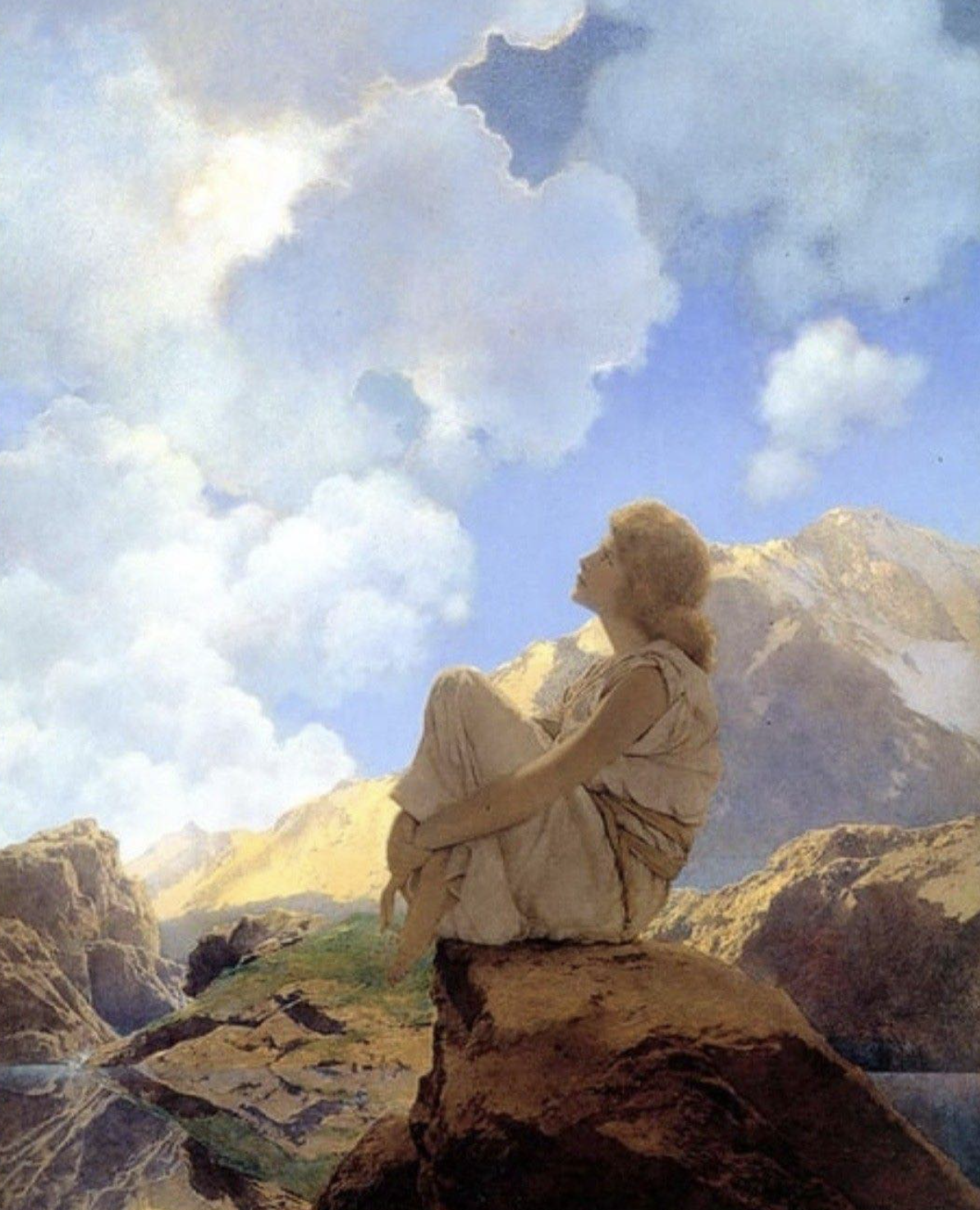
Morning—Maxfield Parrish, 1922
All cultures seem to have sacred sites. They exist; they were “created.” Human nature compels some to “celebrate, commemorate” them by adding structures of some kind or enclosing them for their own purposes. Other cultures, including Indigenous and Native cultures, proceed instead by identifying these places, giving them names—often descriptive and mystical—and handing those names down through the generations until the names themselves come to identify the sites. The sacredness needs no edifices, which can deteriorate over time or be destroyed by succeeding cultures.
Do these two vignettes suggest anything about how we, as humans, relate to our surroundings?
Over the last several decades, I have become concerned about where we are and where we are going. These thoughts about sacredness and changing ways of being tend to question whether our individual natures are a reflection of a larger change in our common, shared culture. Have we chosen a path of least resistance and failed to give proper attention to the “road less taken”? Have we chosen “conventional wisdom” over creative thinking and more fruitful alternatives?
Do you know the term conventional wisdom? It is worth knowing the phrase and understanding how it works and affects our very lives—individually and collectively.
Allow me a moment, and then we might just have a conversation:
While the exact two-word phrase appeared occasionally in the 19th century as a neutral synonym for “commonplace knowledge,” an economist, professor, and writer, John Kenneth Galbraith, fundamentally redefined and popularized it in his landmark 1958 book, The Affluent Society.
Galbraith specifically used the term to describe ideas that are widely accepted not because they are inherently true or empirically proven, but because they are comfortable, convenient, and predictable to society. In his view, “the conventional wisdom” acts as a powerful form of societal and institutional resistance, protecting people from the painful work of updating their beliefs when real-world facts change. (Paraphrase of a Wikipedia source.)
Pay special attention to that paragraph:
“...the ‘conventional wisdom’ acts as a powerful form of societal and institutional resistance, protecting people from the painful work of updating their beliefs when real-world facts change.”
Do you see evidence that we are in this situation today because we bought the idea that individualism and its accompanying “freedom” were better than “collectivism” and regulation? And because, though capitalism had some drawbacks, it was better than the “alternatives,” why not just stay with the status quo?
Look where it has taken us...
With respect to our beginning paragraphs and questions about two opposing ways of “thinking”—natural beauty and the sacredness of our inherited environment versus exploitation and utility—does that feel “true”?
In just five short decades, we have traveled from Rachel Carson and Silent Spring and the creation of environmental protection legislation to unbridled destruction of natural resources for private gain.
How should we expand on and finish this thought?
I am tempted to call this little retreat on the Carolina shore a sacred place. But even as I have that thought, it seems somehow presumptuous to do so. Have I the right, when I speak to others, to cite years, centuries, over which a place has been “worshipped” by generations of minds? Yet...
And what about a small hill called Jomeokee? My feelings for it are mostly derived from the decade or so during which I merely had the privilege of tending a crop, sharing the space with a variety of non-human creatures, and witnessing the phenomenon of the setting sun as it almost disappeared behind the “pinnacle.” This feels more worthy of my claim of sacred places because I am sure that the Saura people must have felt the same way about their “guiding place.” And other pilgrims on the old “wagon road” must have had lofty thoughts as they sought their own promised land in the shadow of the Appalachians. Were they not “pilgrims” in the truest sense? Must they not have retained memories of that quest and passed them down through generations, telling stories of the small, conical mountain and following its pathway—its guiding presence and sense of direction toward personal promise?
Yet, what about this seemingly insignificant little piece of a thousand miles of Atlantic coast? I can only say that those of us who have, for over six decades, spent precious time feeling that we have arrived at a small slice of paradise—are we not part of an adoring Tribe?
But I finally wonder about this little planet itself. Might we be presumptuous in calling it a sacred place in the cosmos? Think a moment with me to contemplate that question. What if, somewhere back in celestial time, the creators, as they watched the ever-evolving state of the universe, noticed a small blue dot? They might not have noticed it before because it circled a minor star among the millions of those that have become known as the Milky Way.
Amused, they wondered why it was such an unusual color in the spectrum. Upon closer examination, they peered through clouds and discovered the blue of the oceans and the brown, green masses that seemed solid and did not move as the sea seemed to. One of them exclaimed the universal equivalent of “wow”! Their collective mind could not let it go and visited time and again, wondering whether the phenomenon might appear, or already exist, elsewhere. It was all new and marvelous to them. Might one try to see into the mind of the eternal creators and interpret the “wow” as a recognition of “sacredness”?
And one more possibly sacred thing. What of the eighth of an acre of shaded privacy that is on the north side of the porch and our private backyard, from which we marvel at the revelations that we are given during each “blue hour”? Yes, a personal sacred place.
Where have all the seekers gone?
Have they finally reached the mecca that the prophets of the free market promised, only to find it in ruins? Will they have learned a lesson in their faithful, failed belief in the gospel of the “conventional wisdom” of prosperity for all?
Might they return to a search for beauty and the lessons to be learned from our rapidly vanishing natural world... in time to make a difference?