
The Mr. Wake Forest I Knew
Edwin G. Wilson
February 1, 1923-March 24, 2024
“To be at Wake Forest is to be at a place that I could love no more, and to be with people whom I could love no more.”
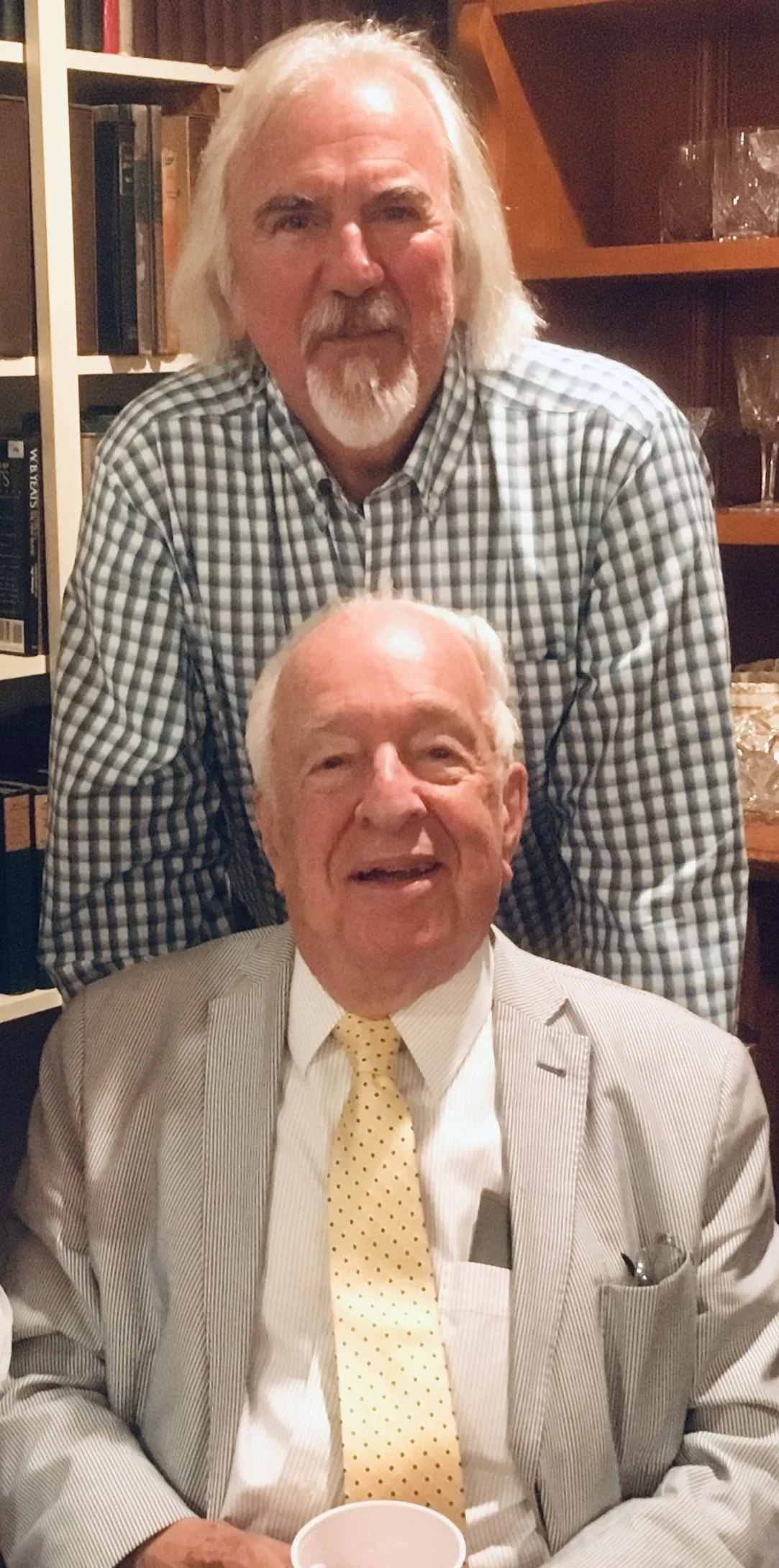
Me and Ed at a “Spring Fling” party in his home in 2018
Dr. Wilson came to Wake Forest as a student in 1939, taught for one year after service in WWII and returned from graduate school in 1951 as a faculty member in the English department. He was successively a department chair, dean, and retired in 1993 as the provost of the university. We called him Mr. Wake Forest. I was honored to be able to call him friend. He is one of a handful of folks who have been the most influential in my life.
I left Clemson University in 1991 and became a member of the WFU faculty. At our new faculty orientation, he talked for forty-five minutes (no notes) about the university’s history.
His voice, his eloquence, and his clear admiration for the place prompted me to say to myself: “you are home”. That did not change.
Within a semester I was invited to join an informal group of faculty and administrators called the High on the Hog Society. Its sole purpose was to share, once a quarter, a meal at one of the many fine barbecue restaurants in the area. We would receive a message from the “Chief Hogistrator”, assemble, and carpool to our destination. On my inaugural Q-run, a car picked me up at the curb and when I slid into the backseat, there was my inspiration (and soon to be hero), in the flesh. We hit it off immediately (Ed never met a stranger) and talked all through lunch about our favorite experiences. This was one of many such moments to come.
When he died at 101, I put pen to paper and wrote an appreciation of my life as his friend, sending it to his wife Emily—a very fine writer herself. It was sent to her as an an intimate act of remembrance, never intended for publication.
His public stature and long tenure to Wake Forest are widely known, yet I was extremely fortunate to have known him more intimately, sharing many precious moments in his presence.
So, on this day, when he would have celebrated his 103 birthday, I offer this once private remembrance to you, to mark the occasion and to celebrate a well lived life. My hope is that those who read this will feel some of what I felt then…and what remains with me still.
Edwin Graves Wilson: Through Existential Eyes
December 13, 2024
Ursula Le Guin is one of our greatest, and most underappreciated, writers. She is best known for her “future history” novels about the Hainish, a civilization that seems to have outstripped other races on other planets and seeks to establish contact with them by peaceful means. My favorite is named “The Telling”. It concerns a planet on which a new government, based on commerce, seeks to cancel historic culture by creating a common state “religion”. It banishes books and destroys libraries and bans all other religious and spiritual practices that might threaten the controlling authority.
In rebellion, an underground society arises with emerging leaders who are mature, mostly from the countryside and small villages and who lead seemingly unimportant lives. They hold secret meetings, and store and protect the remaining old books and texts. In each community cell, stories are told and memories shared in order that they remain “alive” for future generations. These gatherings are called “tellings”.
When we lose someone, their lives, no matter how loving and well-loved they were, tend to become lost, disappear little by little.
They live on only in our collective memories. The life of any of us can only be truly revealed through a melding of many “tellings”. No single person can tell their story; we all experience them differently.
This story is only mine to tell. It is a deeply personal, anecdotal, tale about how my love and respect for Dr. Edwin Wilson was forged by the privilege of proximity and informed by direct observation and years of interactions.
Who am I to tell you this? But that is the point. No one else can do it, any more than I can tell yours.
I do not claim that my view is an unbiased account. From the first introduction I had to Ed, I learned that ideals exist, that they can be lived and consistently observed in a single life. Others may tell details of a long, illustrious career. This telling is simply my idiosyncratic attempt to add an illuminating light to the shining example that was our centenary gift.
In the fall of 1991, a mid-career “scholar” arrived on the Wake Forest campus looking for a home. His path had meandered over familiar red clay hills and through flaming desert sands. The journey, though enlightening and revealing, lacked true fulfillment. The wonder of academe, the spanking new freedom of the mind, had begun to wane under the glaring face of reality. As we all know, ideals seldom stand up fully when put into practice. Yet one must always continue to hope the journey is not being undertaken for naught.
On one shining day, over the course of an hour, the old dreams broke through, and the waning myth was rekindled. The beaming face, the mellifluous voice, the overflowing spirit of warmth and welcome, told the tale of a place clearly apart, and very deeply loved. At that moment, the promise of a spiritual resting place for a tainted vision was revealed. Ed Wilson, in all his glory, hinted that the journey had taken on new meaning as he retold the history of Wake Forest. What a welcoming message for a doubt-ridden prodigal to hear.
The big question is how does one capture the essence of a true phenomenon?
I have never known anything like it.
So long and so prominently in a place that it sometimes seems to bear his name as much as he has come to be called by the name of the place. For Ed Wilson, from his late boyhood throughout his long “retirement”, Wake Forest and the man seemed completely intertwined, at least to the observer. Certainly, from my first viewing and listening experience of him, he was my Wake Forest personified.
What follows are my personal reflections, offered through a series of anecdotal moments, as they first came to me.
I have a propensity for all things “barbecue”. Quite soon in my early tenure, I learned of an elite organization with the highfalutin title “The High-on-the-Hog Society”. Informally—but very officially—membership only came through an invitation by an existing member. Somehow, I was invited to one of its events and soon found myself in an official vehicle, bound for our designated meeting place. As I slipped into the back seat, I was amazed to find my fellow traveler was none other than “Mister Wake Forest” himself. For the twenty-minute drive we talked as if we had always known each other about one of our favorite topics—the virtues of smoked and chopped pork. Soon enough I found myself regularly side by side, at the table, with my once and future idol, whom I now called friend. Over the ensuing years, we repeated similar forays—both with The Society and on more intimate trips—often in the company of our esteemed colleague Dr. Herman Eure, whose presence will appear again in these pages.
There was an added benefit and a very fine one. When my son entered Wake Forest in 1996, I asked Ed (careful not to impose on our growing and special relationship) whether he might serve as Stuart’s academic advisor. He gladly made it so. Ed was still teaching then, and his poetry classes were almost impossible to get into. Not only did my oldest boy have Mr. Wake Forest as his advisor, he also managed to take two of his poetry classes. Ultimately—and I believe largely because of Ed’s influence—Stuart became every ambitious parent’s nightmare: the dreaded “English major” (or to me, someone’s wildest dream).
Over the next several years, as I came to know the institution more fully, I asked for an audience with the retired—but still very busy and active—Ed. On one such occasion, after my love and respect for the greater WFU had grown dear, I visited his designated “throne room” in the university library.
My concern at the time was that after a decade into my life as an acclimated member of the faculty, the university’s essential nature was changing too fast. The new millennium was upon us. I asked, simply, “Do you feel it too—and if so, what can I, what can we, do about it?”
His answer, characteristically diplomatic, was this: “Clay, go out and find all the people on campus who share your concern, and work among yourselves.”
I wanted a revolution.
He suggested a conversation.
In frustrated silence, I departed with my proverbial tail between my legs.
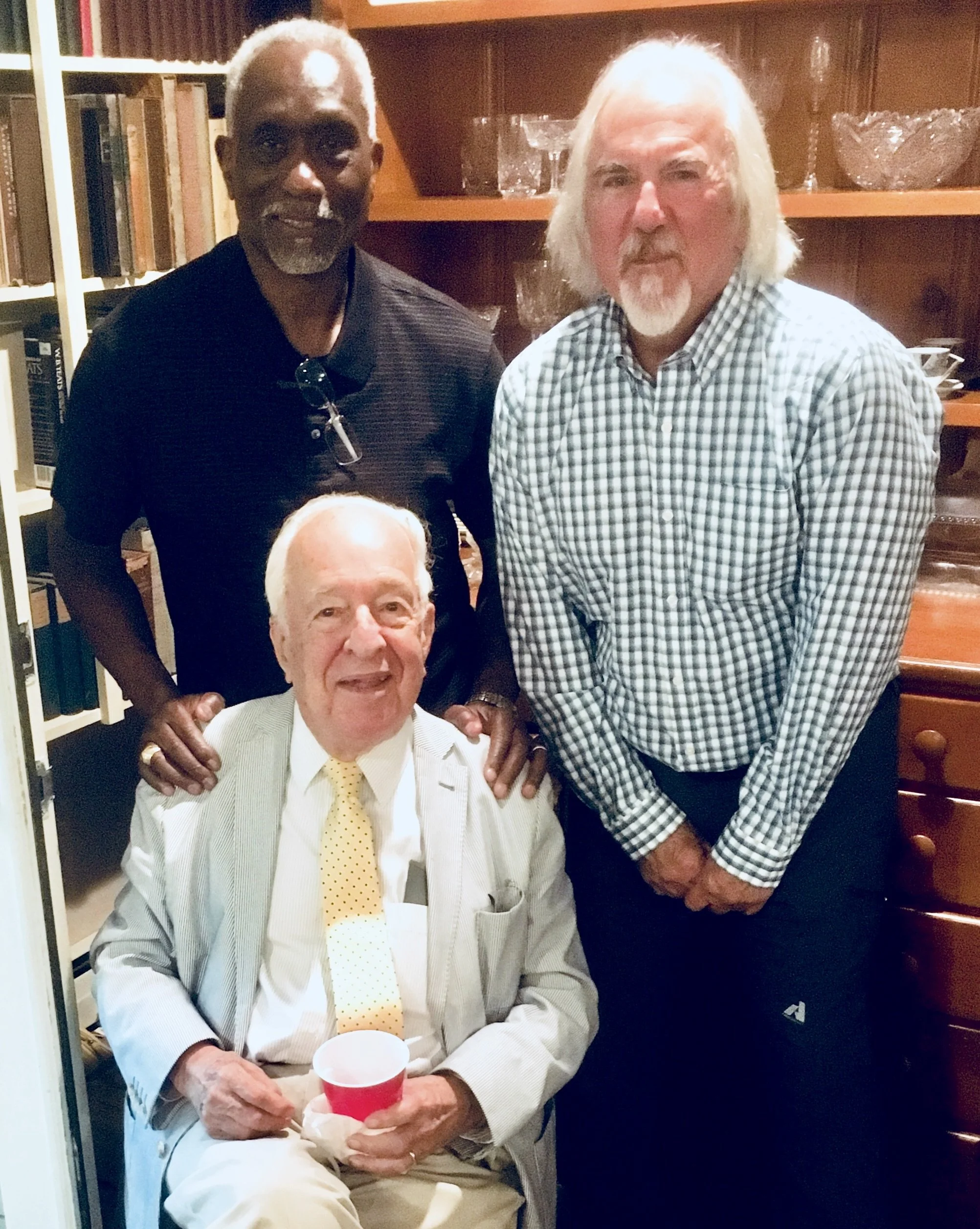
Ed, Herman and Me
Dr. Herman Eure and I had been dedicated companions as runners during the noon hour from the first week I came to campus. We were fellow confidants and mutual therapists. Our strongest bond? Our love for Ed Wilson. We began to become concerned that, despite his long term, continuous “reign” of distinction as Mister Wake Forest, his legacy was not being officially documented. Perhaps, we worried, his distinction was being too much taken for granted. We began to lobby for an official, visual, commemoration of his life and history with the institution. Our chosen vehicle would be a documentary of him on the old campus in Wake Forest town.
For several years we sought funding and support to mount a trip, hoping to send a small crew and entourage to capture him in his element. We were unsuccessful. Then, out of the blue, we learned that a new member of the Communications faculty had arrived, someone who had significant experience in filmmaking. Suddenly, through a series of conversations with him, funding was secured and a plan set into motion. (An aside: the project found new life through the university’s advancement efforts, tied to a broader fundraising campaign. This meant that Dr. Eure and I would not be in control of the project or its content in the way we had envisioned. Still, it was going to happen, and our hope of capturing one of the university’s greatest treasures would be fulfilled.)
On a glorious spring day, an entourage wound its way through the Carolina midlands, setting up cameras at various locations on and off campus. Among the stops was Shorty’s Diner—the pool table still dominated the backroom— where hot dogs and cold drinks were shared, along with conversation about the “good old days” with Ed and a former, long time Chaplain (and equally famous) Ed Christman. They reminisced about movies across the street and late-night snacks. Magical.
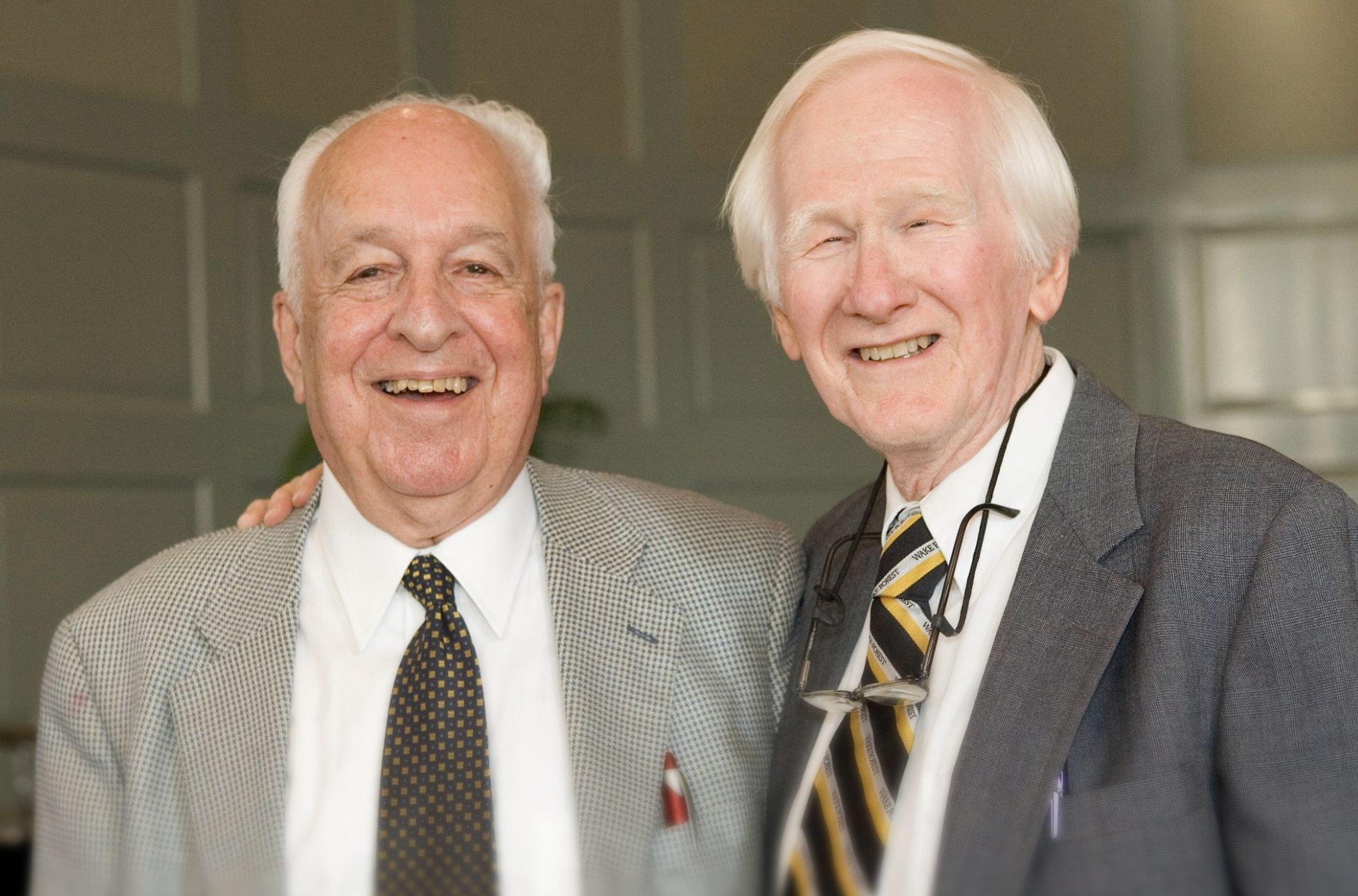
Ed Wilson and Ed Christman
We strolled through buildings and grounds capturing more candid conversations with Dr. Wilson and Ed Christman. As the day drew to a close, Dr. Ed was captured on video giving an informal soliloquy on what it was like living and teaching in the “home” of the university on the Old Campus. Earlier he had reminisced about his love for athletics in the old gymnasium, including anecdotes about particular players and contests. Throughout all of this, we were continuously amazed by the command of his memory and the precision of his recall—he was already well into his eighties. As we filmed his historical summary, outdoors, the director realized that ambient traffic noise and a too sensitive microphone had probably ruined the audio. He asked Doctor Ed if we could start over (the talk had consumed the better part of a half hour), he graciously consented and quoted himself almost verbatim from memory—there was no script.
Looking back on that time—a whole day watching Ed, or standing at his side—one single anecdote seems to define the experience. Even if Herman and I had only been mere observers it would have been enough. Instead, as the instigators in some real sense, we were privileged to be made a part of his memories and, indeed, the spirit of Old Wake Forest, as it could only be told.
We stood in the gym, somewhere around mid-court. He pointed out where his seat was (as if he ever used it!) and told us of the Duke game in 1953, when Dickie Hemric scored a game-high forty-four points to seal the victory. (For those who do not know, Hemric was a superstar in two sports—you ought to look it up.) Through Ed, we were as close to being there as one could be.
Wake Forest Athletics were a huge part of Ed’s campus existence. He served the college as its representative in the conference and the NCAA. He probably attended every game as long as he was able. (Certainly a personal record among Deacon fans).
The day ended with a stop at the “legendary” barbecue establishment Allen and Sons, near Hillsborough (the owner was still splitting his own hickory for his pits in 2004). We sat with Ed, the Christmans, Mary Beth Wallace—one of Ed’s greatest admirers and collaborators—and the camera crew, continuing to swap richly textured stories.
Ironically, though we were still relatively close to the original Wake Forest Campus (located in Wake Forest, NC), Herman and I learned that it was Ed’s first visit there. It felt like a genuine privilege to be able to claim that honor with such a legend—and devoted connoisseur of NC Barbecue.
A few years later Herman and I engaged another camera crew and had a long conversation with Ed in the balcony room of Wait Chapel. Again, try as we might, we were unable to interest the “powers that be” to create duplicate copies of the conversation in some format to share with the larger Wake Forest community.
But we did it—we had the intimate experience—and we have copies in our private collections to view, as we will, whenever we need a “fix”. Have no doubt—Ed Wilson was a trip.
But, most of all, we have our memories, and the sharing, and the caring, and the mutual loving. My wish is that everyone reading this modest effort could have experienced this man Ed Wilson in his ever-present glory. He was, throughout, a friend, a gracious supporter, a gentleman scholar, a poetic speaker, a mentor of generations of students and faculty, and the finest public face that any institution could hope for. I wish you could have heard him read Christmas poetry in the small chapel under Wait Chapel! His favorite was by Christina Rosetti made into a song: “In the Bleak Midwinter”.
In our last, public, encounter, a group of us celebrated the birth date of another Wake Forest institution, Bill Starling—the longtime admissions director—in yet another barbecue restaurant. Ed, at one hundred, came in his wheelchair and mostly listened hard (the place was crowded and loud). Despite his hearing aids, Ed struggled to hear and understand greetings and questions from old friends and admirers. Nonetheless, he spoke lucidly, and we were all inspired and amazed to be in his now legendary, centenary presence.
Ed, my hope is that others may tell “their” stories at every opportunity in order that the tradition that you represent will live, in truth, in the hearts and minds of anyone who has served, or simply loved, Edwin Graves Wilson University (aka, Wake Forest).
If I had gotten wealthy from an illustrious academic career (wink), I would donate enough to the institution to create an endowed chair: a Distinguished Professorship in the Liberal Arts and Humanities. The position’s main role would be to create courses and forums whose purpose was to reinvigorate and enhance and reinstate the college’s emphasis on its inspiring motto, “Pro Humanitate”. If possible, there would be an annual event during his birth month that would bring scholars and distinguished voices to the campus for a weekend of the most vibrant celebration of Wake Forest’s finest son. There would be poetry.
A.R. Ammons, a North Carolina boy like Ed, was one of his favorites. His tribute to Ed:
For Edwin Wilson
By A. R. Ammons
Did wind and wave design the albatross's wing,
honed compliances: or is it effrontery to
suggest that the wing designed the gales and
seas: are we guests here, then, with all the
gratitude and soft-walking of the guest:
provisions and endurances of riverbeds,
mountain shoulders, windings through of tulip
poplar, grass, and sweet-frosted foxgrape:
are we to come into these and leave them as
they are: are the rivers in us, and the slopes,
ours that the world's imitate, or are we
mirrorments merely of a high designing aloof
and generous as a host to us: what would
become of us if we declined and staked out
a level affirmation of our own: we wind
the brook into our settlement and husband the
wind to our sails and blades: what is to
be grateful when let alone to itself, as for
a holiday in naturalness: the albatross, ah,
fishes the waves with a will beyond the
waves' will, and we, to our own doings, put
down the rising of sea or mountain slope: except
we do not finally put it down: still, till
the host appears, we'll make the masters here.