
Growing Up, and Into, Music
“Matter delights in music, and became Bach”
—Ronald Johnson
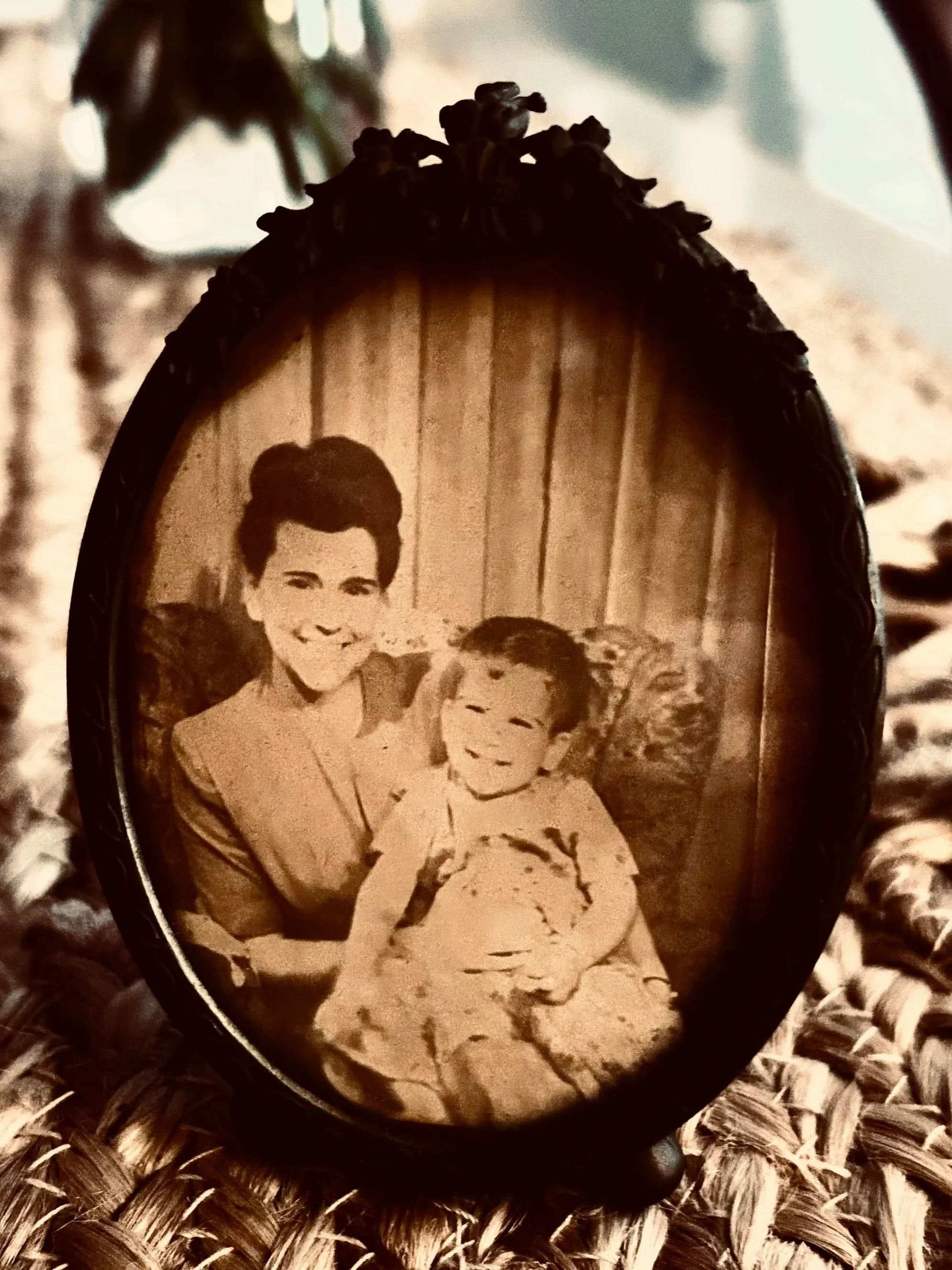
My Mother: Evelyn Chambers Hipp
This morning, I want to talk with you about music. It is a major contributor to the person that I am, that I have become. My mother introduced me and my little brother. She was an amateur pianist, an alto in our local church choir, and an advocate of truly “listening” and making music “instrumental” (more about that below).
For me, offering music to others seems almost like a personal duty as a result—a sacred trust.
A major component of this site is, and will continue to be, a separate blog about music in general, but specifically, here at the start, a radio-like show. Shortly, we will be offering a program called “Words That Sing.” If I were to be more audacious and descriptive, not to mention presumptuous, it might be called something like Poems That Sing: The Transcendent Power of “Lyrical” Music.
Each week, we will be offering the works of artists who write (and sometimes perform) music that transcends mere tunes and lyrics but is rather a melding of the two. Neither of the two would have the same impact on their own.
This is a conclusion and conviction I have reached from decades of listening to and occasionally singing them.
I believe a few things deeply:
— “Music hath charms.”
— Songs touch us at an essential level
(just as all good art can).
— We do not truly “listen” to music very well.
And if we did,
our lives would be significantly enhanced.
For me, it is a shame that in our busy lives the only music we experience on a regular basis is “ambient”—a backdrop to our lives in places of business, as we relax at the end of the day, and to create moods for our special moments, which seem to be getting more and more rare.
So, in this hour or so each week, I will be asking that you join me as I attempt to make my case.
If that is my task, please allow me to give you a glimpse of my inspiration and motivation with this little musical “résumé.” 😊
If I were you and was being asked to go on a literary journey, I would want to know, up front, who was speaking to me. That is just who I am. I have learned from personality and experience, during a long, rewarding life, that it is important to consider the source.
It is not so much lack of trust.
I am not, by nature, a skeptic.
I just do not want to waste any of my precious time considering a serious topic, such as this one, without having some idea of where it is coming from and what has informed another person’s care for the subject.
In other words, it is always prudent to consider the source.
I should tell you, for what it is worth, that what follows began as a somewhat whimsical little piece, an introduction to a much larger work that I have been working on for several years. A work that has taken on a small life of its own. I keep rewriting it because I have not yet captured the right “voice” that might attract a wider audience. My first and second efforts proved too “narrative,” even “professorial” (as per my previous vocation).
Maybe sometime it will see the light of day.
Until then, humor me, please.
Let’s go….
Growing Up, and Into, Music
This little book is the “child” of a baritone ukulele.
It was a gift from my mother at Christmas 1963, before my senior year in high school. I have come to believe that it was symbolic of her disappointment, a decade earlier, when I chose baseball over piano lessons.
Over the next year, I practiced and played simple three-chord arrangements whose identities have escaped me. I only know that by next Christmas I could play and sing without being embarrassed. During practices for our senior play, I surprised my classmates with singalongs. They knew me only as a very good student and a “fair-to-midlin’” multi-sport athlete. We had one classmate who played piano and who would become “most talented” in the senior yearbook. A very attractive young lady friend gave me a boost when she confided that, if she had known about the ukulele, she would have voted for me instead.
The summer of 1964 found us in a summer of love and protest. My favorite songs became “If I Had a Hammer” and “Blowin’ in the Wind,” and I worked hard to learn them both. They served me well as I went to summer camps and Methodist Church youth assemblies.
I was a traditional southern boy, so this was my only contribution to the nascent protest movement sweeping the country.
It felt good to “hammer” out the energetic chords of Pete Seeger’s lyrics at parties. (I was bold enough to sing Bob Dylan’s “The Times They Are A-Changin’” from the back of the sanctuary one night when the youth were in charge of the service.) Later that summer, I attended a “Youth and Missions” retreat at Lake Junaluska, NC (a lovely denominational summer getaway in the Smoky Mountains).
Two significant things happened there.
Musically speaking, I met another “performer” who would become a friend as I entered college that fall. He played a “banjo uke” better than I could the baritone. We worked up a small repertoire of songs and regaled the young lady attendees with our sparkling personalities and (quite good) harmonies. The power of song was not lost on us.
The other formative moment shook me to the core.
At that same retreat, on a bus trip to an outdoor play, we stopped in a small town for snacks. A “liberal” pastor, who was leading the trip, came on board and announced that we were going to have a “sit-in” at a diner nearby because of a racist sign in the window. A goodly number participated, but I chose to remain in the back of the bus with a young lady who was fast becoming a “girlfriend.” We were from small towns and scared to death about being arrested. The protest movement had become real.
All that is to say that playing music became a more conscious endeavor.
The emotional excitement of playing music began to take form and join with the real and symbolic lyrical content. Without truly “knowing” it, I was aware for the first time of the poetry of songs I had learned.
Over the years, this realization never left and has brought me to this day—and to this writing.
The baritone uke soon spawned a six-string Gretsch classical guitar, which became my true musical companion and led me to become a member of a trio that played together through college. It also gave me many magical nights around campfires at summer camps where I was a counselor.
The final piece of my introduction to, and love of, playing live music was a gift.
In college, I was a member of the men’s glee club. We sang at college events and various local holiday celebrations. We took a spring break tour each year to destinations in the Southeast (New Orleans, Florida, and D.C.). We sang in churches and civic clubs and a country club or two. At the end of my first year, a duo who had played during intermissions graduated. The choir director approached three of us, who were “known” as musicians, and suggested we put together a trio to replace them.
After discussion, we accepted and became “Those Guys Again”—figure it out for yourself.
We were “folkies,” children of the sixties (Peter, Paul and Mary; Bob Dylan; Pete Seeger; Woody Guthrie—and even a Beatles number!). Our first song was “Early Morning Rain” by the Canadian giant Gordon Lightfoot.
Off and running, we played around town at civic clubs and church groups and the like—no money, just fun and occasionally a free meal. At the end of three years, we were pretty pleased with our sound and a growing playlist.
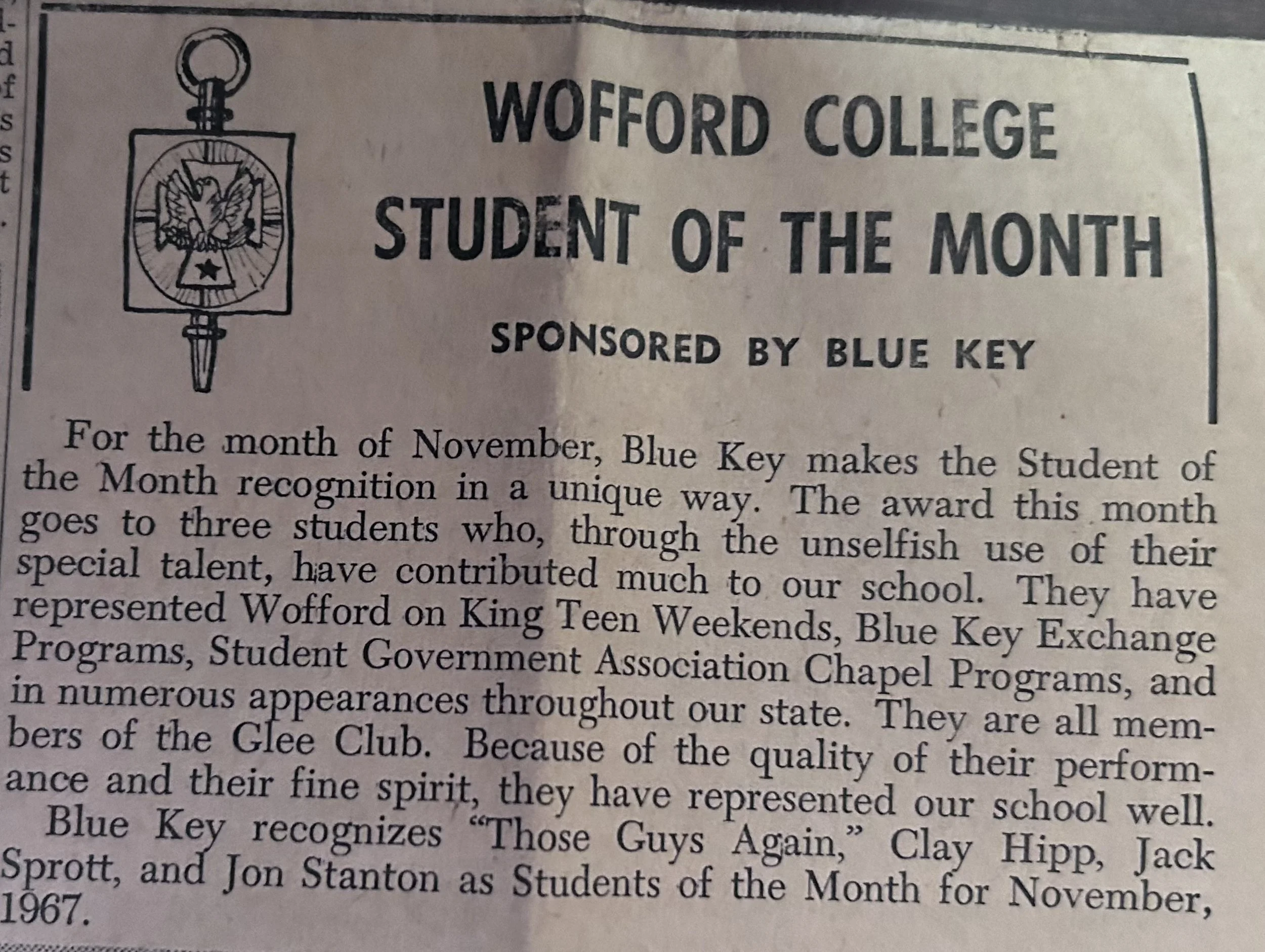
Those Guys Again
Jon Stanton, Clay Hipp, Jack Sprott
(L to R in title picture)
Wofford Glee Club
1967-1968
We continued to add new songs for our various “gigs.” Towards the end of our senior year, we even hinted to each other that we might try to “take it on the road” (one of us had played coffee houses during his high school days). I was going to graduate school and felt free, as did our minstrel member. Before we could talk seriously, the third, and most talented, of us (he wrote and arranged his own music and was a talented guitarist) announced, “I am getting married in the summer.” The end—but a great ride nonetheless, a small taste of possible fame.
It was also a sign that my life was changing, going in a different direction. It hurt a little at the time.
I have come to have that feeling more and more strongly as time has passed. Reflection revealed that I really did have enough talent to succeed in life dedicated to music. I had a lovely (I am told) high tenor voice. I had a rudimentary understanding of music theory based on experience, not technical training.
I had sung harmony and solo in several performing contexts: early church choirs in which I experienced Bach’s contrapuntal harmony along with more traditional hymns; being good enough in the college glee club to be appointed “tenor section leader”; and there is no discounting that the solo and group public exposure gave me confidence and a wide-ranging experience in numerous kinds of music. If I had used my acceptance into graduate school as a deferral from the draft, I and the trio might have hit the road and become real “folkies.”
As I have said, the musical genius in the group was already writing original songs, and the other guy was a traveling solo act in coffee houses up and down the East Coast as a teenager—he was worldly wise, as they say. Instead, I took my ROTC Army commission, deferred my grad school, got married myself, and entered active duty in the fall.
A year later, I was off to Southeast Asia. On returning safe and sound (!), I went to graduate school, practiced a little law, had children, and entered the new world of college teaching. Needless to say, my musical life suffered as a result and took a fifteen-year hiatus (not to say “sabbatical”).
There is another chapter which truly cemented my singer-songwriter obsession. Perhaps I will tell you later (on request)? 😊
Once again, thanks for reading.
Clay