
How to Live—and Why We Write
By Clay Hipp
Writing is excavation: the work of going deeper
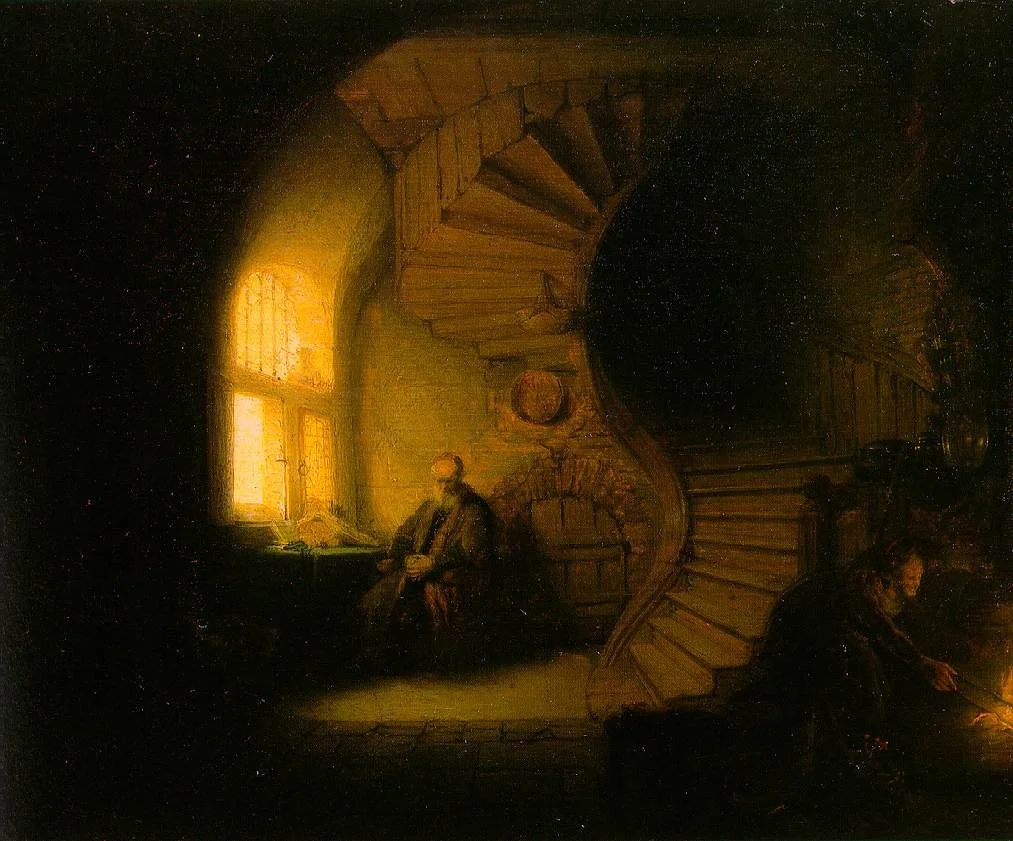
Philosopher in Meditation, Rembrandt—1632
Awaking, as usual, around five, I began to ponder some ideas for the future content of my budding journal.
I had been rather stuck for several weeks, moving between creative pieces and commentary on several topics. My longstanding love of music seemed to hover over every piece, with song lyrics hankering to insinuate themselves at odd moments. I realized that my other love — literature — was being given short shrift.
I sat with that thought for a while, and then started asking harder questions…
The day before, I had posted a list of books, videos, and music I was recommending for the upcoming summer. Along with my choices, I had written short reasons for their inclusion, and it seemed only proper to speak of their qualities. Looking back, I can see that these were, in fact, little critical reviews. I suppose that provided the inspiration for taking a critical look at my own work.
The biggest revelation was this: I was lacking direction.
For six months — during which we posted three times a week — we were always faced with tiny deadlines. Each post was, in fact, stand-alone. It was not a great burden, but I did wonder how it could be lightened.
As I sat in the dark of my "blue morning," pondering, I was reminded of a lovely e-mail from the day before praising the "literature" post as "that was a good one." My next thought was: How can I make my own work more worthy?
The answer that appeared:
To create a stream that follows a theme.
Then, of course — what might that theme be? I cannot say that I received a clear answer, or at least one I became committed to, but a seed was sown.
The question implied that a good writer must, as they say, "follow what provides the most inspiration" — in other words, what gives your thinking momentum. Rather than reveal my tentative answer, I shall attempt to pursue it and let the reader decide.
I will also ask that you remember this day, and give me a bit of time to develop my stream and theme. Only later will I likely discover whether the new quest is achieving any success — but I believe I will somehow know the answer, if and when.
One of my motivating thoughts has been Jens Kruger's Beautiful Nothing — an instrumental composition attempting to convey a concept I have come to believe in: a mysterious "thing" with no true form, but with much substance. Someday I will attempt to "translate" it for you. For now, it is a state of mind I would very much like to achieve. It may just be the secret of life.
(For your enlightenment: the little piece is very gentle, and at one point — about two-thirds of the way through — it stops, pauses for a few seconds, and resumes. I have interpreted that pause as the beautiful nothing moment.)
One of the most influential books I have read lately is How to Live by Sarah Bakewell — about the famous sixteenth-century Frenchman, Montaigne, who essentially invented the essay as a form of literature. Bakewell introduces us by posing twenty questions she would have asked him, then answers them as she believes he might have. His writing was a deep observation of his own life: looking, describing, and analyzing critically what he observed.
(Montaigne was, in a very real sense, ahead of his time. Four centuries later, a branch of philosophy called Phenomenology arose — similar in spirit to his writing — and eventually gave rise to existentialism.)
I have been told that my powers of observation are keen, but since reading Bakewell, I have tried hard to hone them to an even finer level. The idea of the title is "how to live" — not how one should live. That distinction matters.
The quest of my writing life, so far, is to let my work inform my better judgment: a deeper attention to the world around me. Getting the journal off the ground was a grand achievement, but after the newness wore off, the excavation began. Writing and recording three times a week took me deeper place inside of myself. That’s when I began to ask: Is this going anywhere? Am I going anywhere?
From these questions I feel the emergence of a theme, and perhaps a better methodology. My deepest wish for myself and you, dear reader, is that we foster a deeper appreciation for the humanities as a true form of knowledge creation.
These are the moments that I love most about writing. When the written word acts like a long conversation with a good friend telling you a hard truth about yourself: It’s deep excavation. Each layer I remove, each article I post, asks me to go deeper. Most of the time I don’t know what I am looking for but I keep digging, because I think, the digging itself is the point.
The stream I am looking for, the theme I am beginning to trust — these feel like an unraveling, which is, I think, exactly as it should be.
The poet and philosopher John O’Donohue says it best:
“I would love to live like a river flows, carried by the surprise of its own unfolding.”
Wish me luck. 😊