
Metaphorical Death
By Clay Hipp
When a song ends, what leaves with it
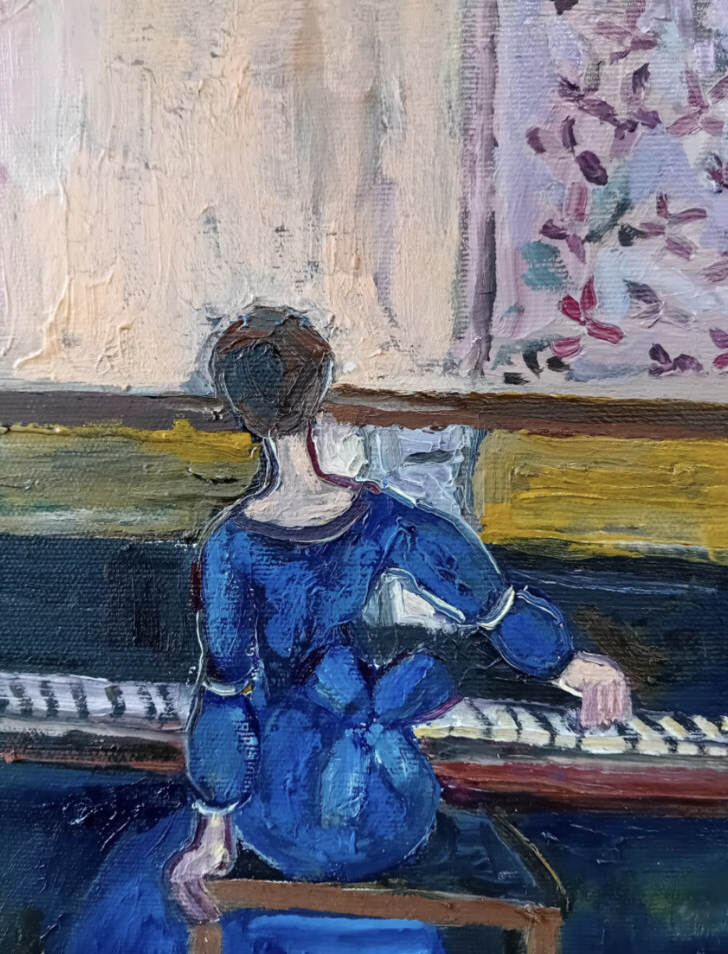
Music 2, Aisté Bugailiškytė, Lithuanian
If you joined us this weekend for "Words That Sing," you heard a set of songs by a very fine — and very poetic — artist named Don McLean. He is best known for a wild, sprawling piece called "American Pie." Many people know it by a single phrase that names the song's theme: "the day the music died." I once called that line ominous. It conjured other ideas for me — "the universal language," the "music of the spheres" — and set my mind wondering: what if that truly happened?
If we treat those phrases as more than metaphor — as our human attempt to search out the true nature of that thing we call "creation" — what would the death of music portend? What might it mean, elementally speaking? Might it mean the end of the world as we know it?
It seems only human to mark moments in time, to celebrate them or to grieve them. Think of Christmas Day, or Easter Sunday. We seem to need symbolism to explain things — to ourselves, and to one another.
That is where my thoughts went. The man who wrote that song was deeply moved by a historical event — the untimely death of one of his favorite musicians — and he lived with it for a decade or more before setting it down in music, trying to describe the long stretch that followed (the nineteen-sixties), both for himself and for those around him. Something had ceased to exist for him, and the music he remembered was heading in a very different direction. Was he, perhaps, reborn in the writing?
I once experienced a loss of my own. A musician whose songs had filled my life was killed in a traffic accident. I had gone to his concerts a half-dozen times and owned every one of his records. He was not merely a superb musician but a master storyteller — his songs told tales of human triumph and of no small amount of loss. He was funny and caring, and he gave himself to a series of charitable causes, one of them his own, dedicated to ending world hunger and sustained by the proceeds from his concerts and records.
Following his death in 1981, there was an emptiness in me that was filled only when I found another group whose music was different but every bit as humane, and every bit as beautiful, with stories of its own to tell.
It never occurred to me that, when Harry was taken away, some very real part of his music went with him.
Is music so integral to life that it is essential to our consciousness, both individual and shared? Where does it go, or does it simply return from whence it came?
“I can’t remember if I cried,
when I read about his widowed bride,
but something touched me
deep inside.
The day the music died.”
- Don McLean, American Pie
What if each of us is an original piece of music? If so, then the listeners play a part — an integral part — in our song. They hear our themes. They decide whether the key is right, whether we ring in harmony or in dissonance. The music is not fully realized without the other.
And if it doesn't sound right? That is the beauty of it: we are always free to begin again — to compose another movement, another song.
To rewrite the music of our lives….