
Reason to Believe
By Clay Hipp
How a failed academic is still trying to believe
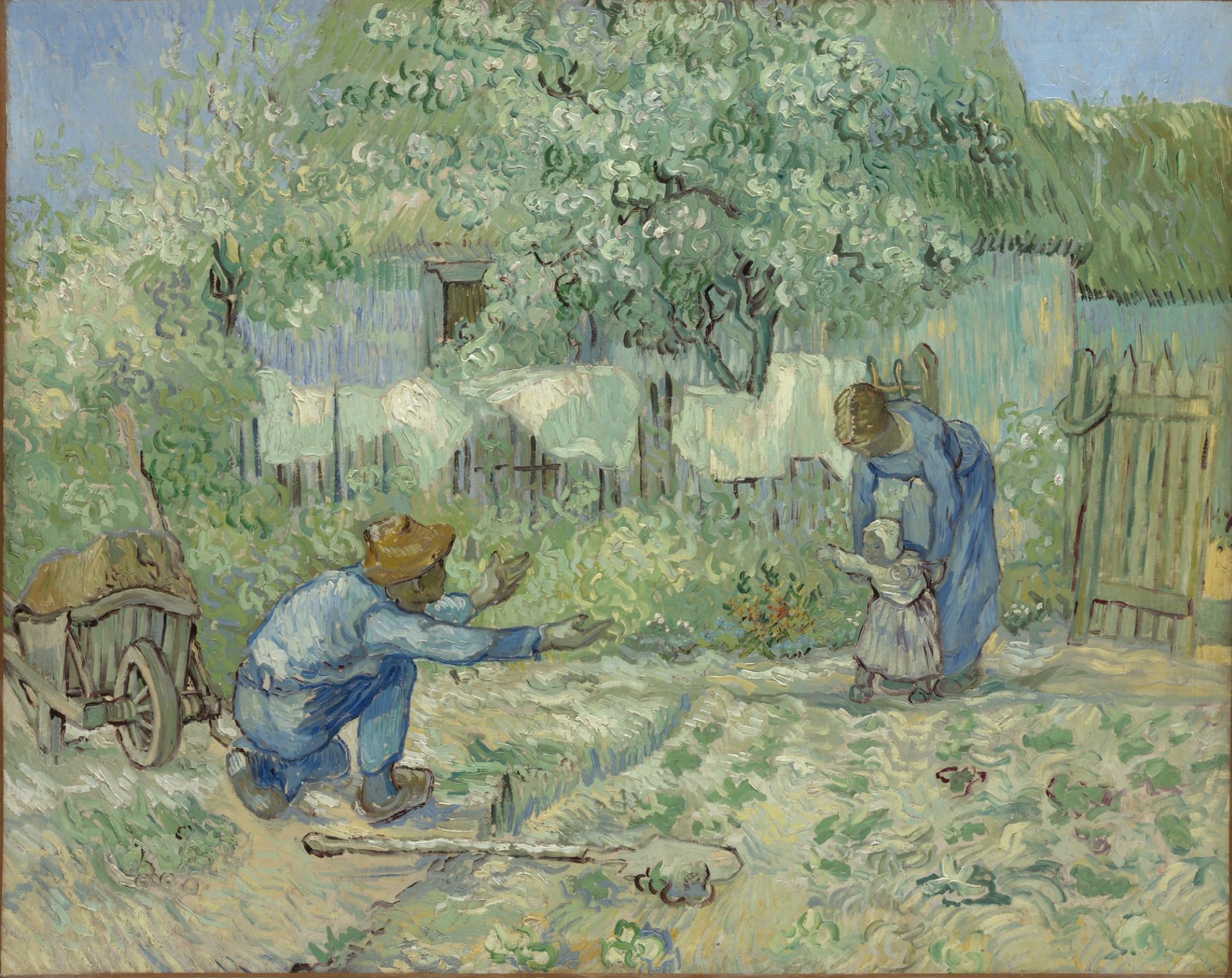
Firsts Steps, after Millet, 1890 - Vincent Van Gogh
I believe, as some have strongly suggested, that music has healing powers. I think it is especially true in the hands of our greatest songwriters. This is from a good one. Perhaps the creative spirit contained here might become a part of the healing process that can aid a renewed belief in ourselves. Read the lyrics slowly and mindfully. What do they say?
If I listened long enough to you
I'd find a way to believe that it's all true
Knowing that you lied straight-faced while I cried
Still, I'd look to find a reason to believe
Someone like you makes it hard to live without somebody else
Someone like you makes it easy to give
Never thinking of myself
If I gave you time to change my mind
I'd find a way to leave the past behind
Knowing that you lied straight-faced while I cried
Still, I'd look to find a reason to believe
If I listened long enough to you
I'd find a way to believe it's all true
Knowing that you lied straight-faced while I cried
Still, I'd look to find a reason to believe
—Tim Hardin (please find and listen to this plaintive song)
One might be saying: this is, obviously, just a broken-hearted love song, right?
So, what is its relevancy here?
When one begins to read and explore poetry, we find that the mind of the reader is a participant in the unfolding of the words, filling in the spaces with individual experience and insight. The lyrics of fine songs are a special form of poetry that should occupy a greater stage alongside the Rilkes and the Whitmans and the Nerudas. When we add music to the words, sometimes the magic happens—look and listen for it.
How might the distraught emotion of the quoted song find a wider meaning?
I am finding in the words of this song a strong metaphor for our times. How so, one might ask? I can only speak from my own personal experience.
I am a failed academic. I conclude this for many reasons, but the present moment has made it much clearer. I taught law in the context of business and its legal environment. My sacred texts were the Declaration of Independence, the Constitution, and the Bill of Rights. I told several generations of our "best and brightest" about separation of powers and checks and balances and the delicate relationship between individuality and the general welfare. I preached that these were the basis of our freedom and liberty and that our democracy was self-adjusting.
The last decade has informed me that these were lies, or, at best, well-meaning and misplaced misrepresentations, and my own incurable idealism. So, in one way of speaking, I have lost my religion.
What if we begin to see the song in a new light? The democracy of which we have been a part becomes personified—a long-term friend. I have loved it and this country for a long, long time. I felt the relationship to be "true." It has now come to an end. I am sad, hurt, disoriented. How could I have been so blind? How could it have deceived me? The relationship is over. I have been lied to all along. And yet…
…I cannot seem to let it go so easily. What if I hang on and listen for any counter messages of hopefulness? If I just pay attention for a while yet, might I find a reason to see behind the lies and discover that in spite of everything, I might believe again in what we had.
The songwriter gives us a basis for hanging on. Someone like you—our democracy—has been such a thing of promise for over two centuries. What could ever be a substitute for such a "home"? Would we find such a thing elsewhere to give ourselves to—this dream of liberty?
Perhaps, after a period of mourning, might we reconsider the relationship in a new light. If we give it up, even physically leave, what have we gained; what is our motive? Is it revenge; are we expressing our individual disgust at being scorned; is this, in the end, our ego speaking? In other words, how could you have done this to me?
At the very least, the plea of democracy was that we must give up a piece of ourselves to create "out of many, one"—to become a more perfect union while thinking of our general, that is, shared, welfare. Should not the dream of our republic once again make it easy to give to the other?
Someone like you makes it hard to live without somebody else
Someone like you makes it easy to give
Never thinking of myself
In the midst of it all, I find myself searching fervently for some "reason to believe." Let me be quick to say that, to my mind, both sides of the aisle have reason to feel that they have been lied to about the promises of the American Dream. This is not the time or place to explore them—they are myriad.
Rather, I want to say to you and myself what the songwriter expresses with great emotion and tenderness, and I have found some solace in it. It is my fervent hope that one or more of my former students might read this verse and find that they could forgive me for any false confidence that I gave them over our "innocent" years together.
If I listened long enough to you
I'd find a way to believe that it's all true
Knowing that you lied straight-faced while I cried
Still, I'd look to find a reason to believe
The promise of our shared democracy is not a lie. Perhaps it has simply been forgotten in the course of our busy and distracted individual and collective lives.
Instead of continuing on that path, perhaps we should heed his other advice:
Someone like you (democracy) makes it hard to live without somebody else (each other)
Someone like you (good citizen) makes it easy to give
Never thinking of myself
Let us pledge to each other as we go forward with our shared blessings and learn to give more and think less of our own selfish desires. And try to "believe that it's all true"—once again….
A great writer had these words of wisdom for us at this troubled time:
“Every age, every culture, every custom and tradition has its own character, its own weakness and its own strength, its beauties and ugliness; accepts certain sufferings as matters of course, puts up patiently with certain evils.
Human life is reduced to real suffering, to hell, only when two ages, two cultures and religions overlap. A man of the Classical Age who had to live in medieval times would suffocate miserably just as a savage does in the midst of our civilisation.
Now there are times when a whole generation is caught in this way between two ages, two modes of life, with the consequence that it loses all power to understand itself and has no standard, no security, no simple acquiescence.”
-Herman Hesse in Steppenwolf
And…..
"We too are living now through such a world, caught again between two ages, confused and conflicted, suffocating and suffering. But we have a powerful instrument for self-understanding, for cutting through the confusion to draw from these civilizational phase transitions new and stronger structures of possibility: the creative spirit."
-Maria Popova of The Marginalian
Seek out the efforts of our artists and writers and composers. Let them feed your consciousness and, perhaps, begin to heal your very personal wounds such that we can find a better consensus within which to live together.