
Sandlot America
by Clay Hipp
Reflections on a Significant Birthday — Mine and My Country’s
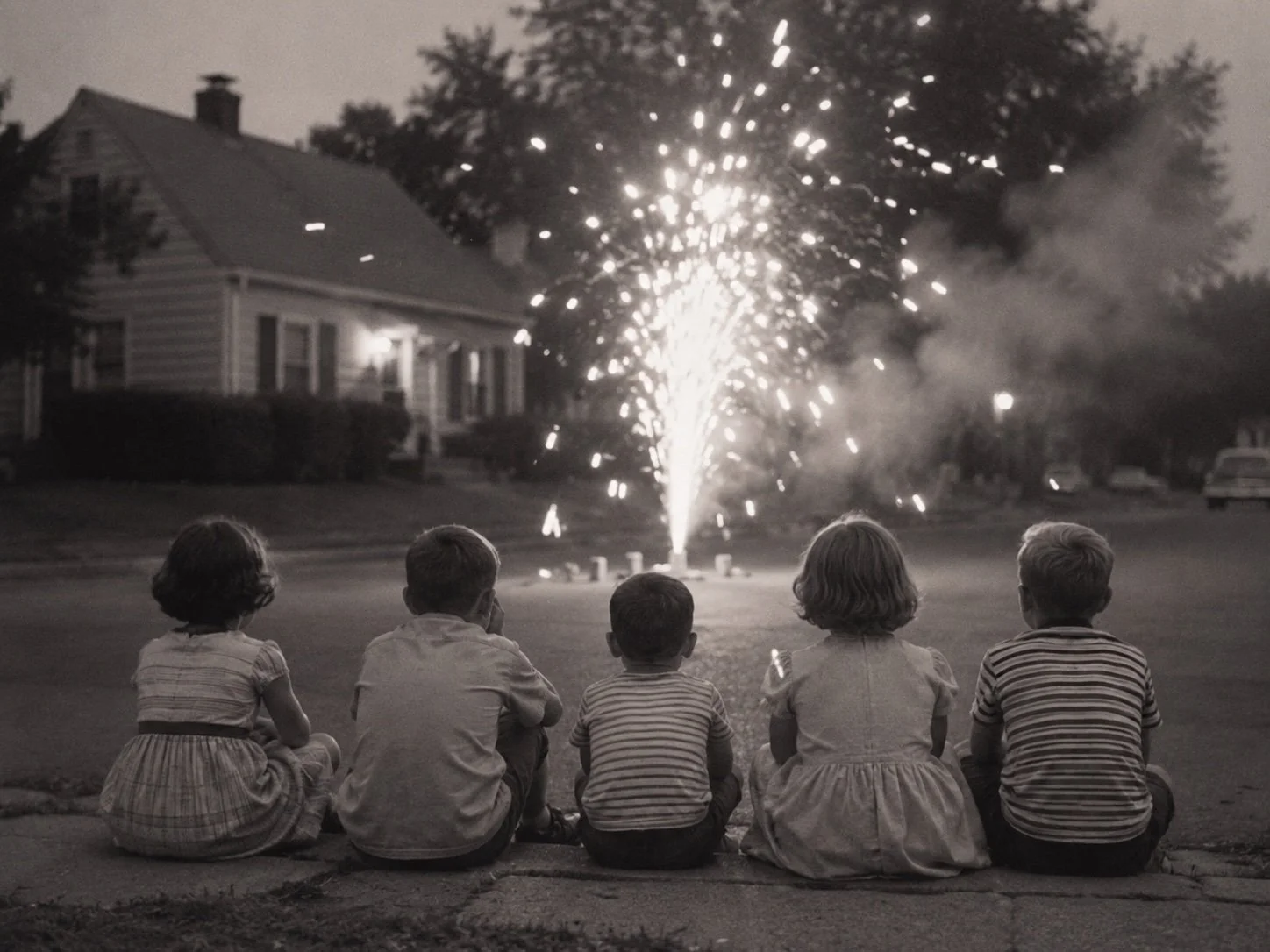
I have never been a big celebration guy, but this might be the toughest Fourth of July ever for me.
It is not even because, on the third, I turn eighty. Rather, it is because I have truly been looking forward to celebrating a big birthday — one I thought I might never reach.
I am even having a wave of patriotism.
Before you jump to any conclusions about that, allow me to say that my status as a “patriot” stems from my love of the idea and spirit of our founding documents: unity, freedom, truths held self-evident, and our dedication to the pursuit of happiness. Patriotic hymns leave me flat. Flag waving has become some ambiguous sign of identity, and it has separated us. But it is the American flag, and it belongs to us all.
Yet, on the eve of a monumental celebration of our country, I feel so disconnected from the planned celebrations. As I see it, this should be about the people of the country, an honest look at our past and present and how imperfect and worthy it all is, not just a personal display of egoism.
Maybe that is what I am trying to say on this birthday, both mine and my country’s: the flag belongs to us all. The country belongs to the people. No one individual can take it away, though one individual can corrupt it to the point that it seems to exist no longer.
Do not believe it.....
I grew up in a small, simple Southern town with traditional values. I am proud to say that despite being completely segregated, socially and geographically, I came to know goodness. My family was blessed to have three true members of our household who were racially different and who worked intimately in our home life — and who shaped me in ways I am still accounting for.
I know. Many I have talked to in these “enlightened times” would pooh-pooh or dismiss that very statement and say something like, “Oh yeah,” as if seeing through our façade. They did not experience the life we shared. We truly loved Pearl Coleman and Sam Fant and Bertha Hopp, and it is my firmly held belief that they felt the same.
Pearl worked side by side with Granny Bessie. Sam did everything for Granddaddy Hipp — he could fix anything and always dressed impeccably. Bertha came to us at twelve to take care of me and my brother. Mother almost died delivering my little brother, and Bertha was with us every day, though she continued to live on the other side of the tracks until she graduated and moved to Brooklyn — her dream. I think about that often. Her dream was to leave. And we loved her, and she went anyway, toward something larger than what we could offer her.
They came in the back door. They could not eat at our table, could not sit beside us in school, could not drink from our fountain, yet they were closer to us than most of our neighbors ever were — in some ways closer than family. That is not a defense of the system. That is an honest look at its complexity — it gave and took from us.
So what, you say — let me tell you, this time through the eyes of a child......
There was a vacant lot across the street where we played every sport year-round. One day a group of young Black kids walked by and asked if they could play. We welcomed them and had a spirited game of baseball. I have no idea if we even kept score. What I remember is that it felt like the most natural thing in the world — that the sandlot had room, that there were enough kids who wanted to play, and that for an afternoon, that was enough.
The next morning the deacon of the church that owned the lot knocked on our front door. He spoke simply and without apology.
This must never happen again.
I have carried those words for seventy years. Not as a wound exactly. More as a question I have never stopped turning over. Because the game happened. It was real. Something broke through — briefly, imperfectly, on a summer afternoon — and then someone knocked on the door and drew the line back.
That, too, was America.
I graduated in 1964 having never gone to school with a Black student. My brother graduated in 1969 and played baseball with Donnie Shell, who became an All-Pro football player with Pittsburgh and its “Steel Curtain.” Together, David and Donnie led my high school to its one and only state championship. Something had shifted, however slightly, however incompletely. The sandlot had gotten a little bigger.
I tell you this so that you can somehow feel that this was the America I went to Vietnam for.
The draft ended, and my brother was not required to go. When I came home to the Army base in my jungle fatigues, I was not a hero but a “baby killer.” Fifty-eight thousand young Americans died. One American paid a doctor to declare that his feet were too bad for combat boots — the beginning of the end of truth.
Some would call the story of my childhood idyllic. It was not. It felt very normal to me. We were all Americans despite our differences — and sometimes because of them. We rode bicycles, played sandlot games, and always let the screen door slam despite our mothers protests. Everyone watched the six o’clock news. We watched the same shows and argued about Fords and Chevys and our favorite teams. And somewhere in all of that ordinary life, something was being built that I did not have a name for then. I think now it might have been called neighbor.
In the fall of 1955, Bertha and I watched the World Series together — the Yankees against the Brooklyn Dodgers. I do not have to tell you which team she pulled for. Jackie Robinson was the star of her team, and she knew what his presence on that field meant in a way I was too young to fully understand. We sat together in that living room, in that town, watching him, and something was happening between us that neither of us had the words for yet.
I was a child. She was not much older. The town had drawn its lines around us both. And there we were anyway, in the same room, rooting for something.
What have I learned in eighty years?
I have learned that goodness can live inside a deeply unjust world. I have learned that love can be real and still not be enough to make a system right. I have learned that nostalgia is dangerous if it asks us to forget the pain that made the past possible. But I have also learned that memory is necessary if we are to recover anything worth saving.
The sandlot was not a just place. The rules that governed who could play and who could not were written by people with more power than any of us had. And yet something happened on that lot — something worth remembering. Not because the injustice did not matter, but because the reaching toward one another happened anyway, in the middle of it, imperfectly and briefly and genuinely. That is the America I am still looking for.
So I long for something, somebody, some movement that can bring some of that spirit back — not the segregation, not the silence, not the false innocence, but the neighborliness, the shared stories, the sense that this country belongs to all of us.
On this Independence Day, search your heart and ask: what must I do for my country’s sake, and for my fellow Americans? Reach across the barriers. Open your eyes and see only neighbors. Greet every single person with a smile. We have no idea what their lives are like. They just need to be acknowledged. They just need to know they exist.
Maybe that is where America begins again — not in speeches or parades, not in the possession of the flag by one party or one person, but in the vacant lot across the street, where someone different walks by and asks if there is room to play.
And this time, let us say yes.
Let us say yes, and mean it.
“Let freedom ring, let the white dove sing
Let the whole world know that today
Is a day of reckoning
Let the weak be strong, let the right be wrong
Roll the stone away, let the guilty pay
It’s Independence Day”
-Gretchen Peters