
Nostalgia—A Riff
By Clay Hipp
what the lyricists know, that the philosophers don't
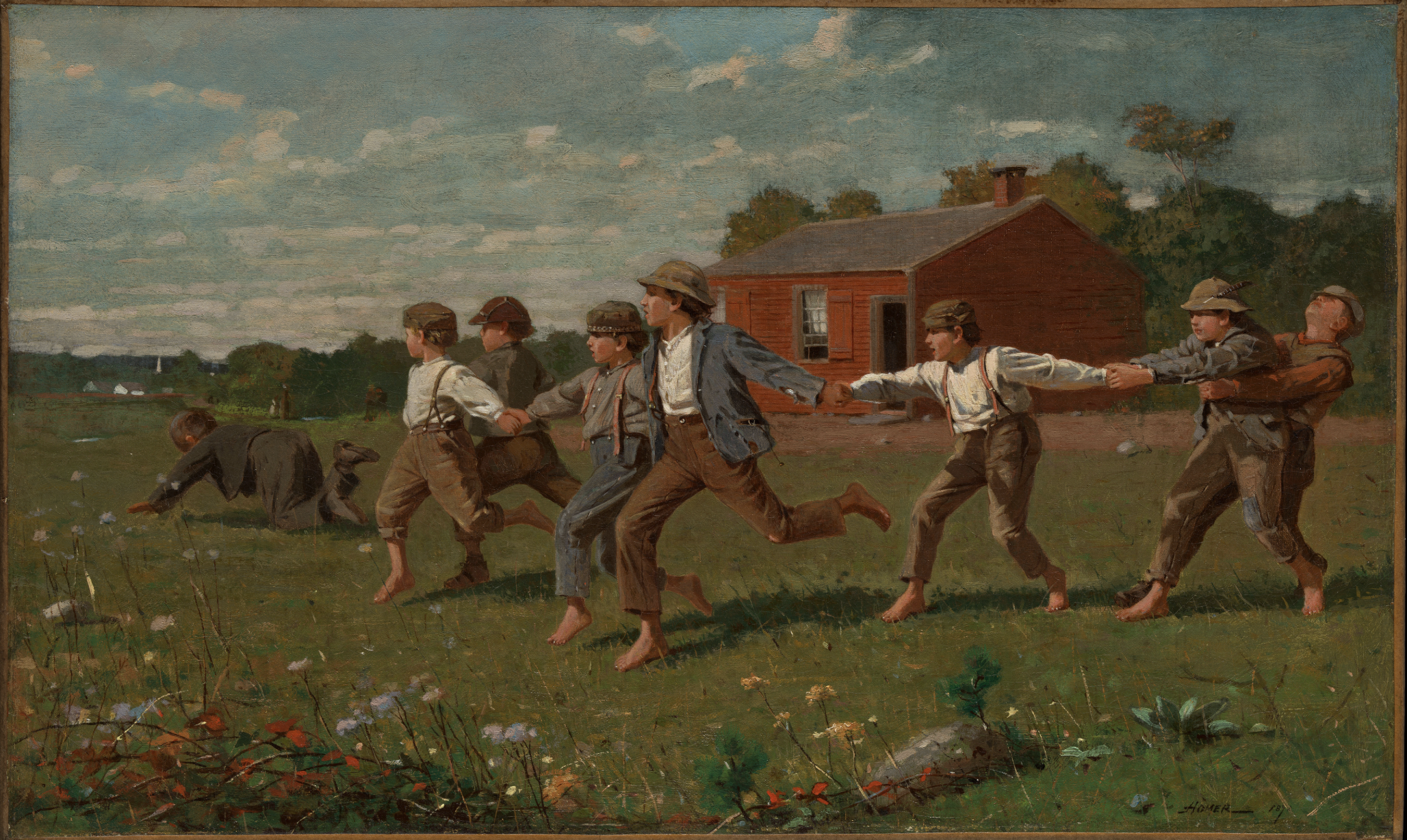
Snap the Whip, 1872 — Winslow Homer, American Painter
I have ambivalent feelings about that word—nostalgia. It can mean simply “wallowing in the past,” which is usually not a good thing. Pining for yesterday gets us nowhere. But when we live in memory for a while and extract the essential truths and the good, then we might just find a way to move forward—together, united.
So these days, when I am feeling betwixt and between about a word or a concept, I no longer consult the linguists and philosophers. Instead, I go sit under the “wisdom tree” and contemplate the words of poets and lyricists. They understand that I am not necessarily seeking answers, but a deeper understanding of life and its confounding dilemmas, offered by people of experience—people just like you and me.
Let's think nostalgic thoughts together.
More than once lately, a feeling of deep grief has almost brought me down—not personal grief exactly, but grief over our mutual loss of “The Way We Were.”
What were we?
Memories
Light the corners of my mind
Misty watercolor memories
Of the way we were
Scattered pictures
Of the smiles we left behind
Smiles we gave to one another
For the way we were
Can it be that it was all so simple then?
Or has time rewritten every line?
If we had the chance to do it all again
Tell me, would we? Could we?
— "The Way We Were." Music by Marvin Hamlisch, lyrics by Alan and Marilyn Bergman, 1973
Those words speak directly to the two sides of nostalgia: the tenderness of remembering and the danger of believing that everything was simpler then. Still, to that final question—would we, could we?—I offer a resounding “yes.”
I have the advantage over many of you. I was born in 1946, one year after my father returned from the war. I was among the very first "baby boomers." Things did seem so much simpler then. Consider what we had: the afterglow of helping the world defeat Hitler, the reopening of the economy, the promise to make everyone's lives better, soldiers getting college educations under the GI Bill. We were all "winners"; we were united (most of us). I know, of course, that the country I remember was not experienced in the same way by everyone. What seemed safe and full of promise to some of us was neither safe nor promising for others. Nostalgia must make room for that truth, or it becomes merely another way of rewriting every line. A famous general became our president, and we were told that the country would be kept “safe” from the growing Soviet communist threat.
Radio gave way to TV. We all watched the same shows and were thrilled by Elvis and the Beatles on The Ed Sullivan Show on Sunday night, and by the wonderful world of Walt Disney. We built superhighways and reveled in our yearly anticipation of new car models. Athletics were still just games — high school, college, and the pros, with identifiable rosters, magical names, and stadiums in exotic cities. (Jackie Robinson, Willie Mays, and Mickey Mantle were names known by everyone; the Dodgers and the Yankees met in crosstown World Series.)
Perhaps what I miss is not the past itself, but the feeling that we once inhabited more of the same world. We knew many of the same stories, sang many of the same songs, and gathered—however imperfectly—around some of the same tables.
Those were the days, my friend. We thought they'd never end.
During the late 1970’s, the great songwriter Harry Chapin wrote:
Remember when the music
Came from wooden boxes strung with silver wire
And as we sang the words it would set our minds on fire
For we believed in things, and so we’d sing
Remember when the music
Brought us all together to stand inside the rain
And as we joined our hands we’d meet in the refrain
For we had dreams to live, and we had hopes to give
Don’t you remember when the music
Was the best of what we dreamed of for our children’s time?
And as we sang we worked for we knew time was just a line
A gift we saved, a gift the future gave
Remember when the music
Brought the night across the valley as the day went down
And as we’d hum the melody we’d be safe inside the sound
And so we’d sleep, for we had dreams to keep”
I know if you have been with me on this site, you have heard this song before, but… it keeps me going.
On Friday night I offered a piece by the progressive rock band Kansas called "Song for America." It is long and beautiful and surprising — well worth your time. After praising the discovery of our "promised land" and telling the tale of the pioneers, sea to shining sea, it suddenly turns pensive, and the final verses mirror the possible world of today.
“Highways scar the mountainsides, buildings to the sky
People all around
Houses stand in endless rows, sea to shining sea
People all around
So we rule this land, and here we stand
Upon our paradise
Dreaming of a place, our weary race
Is ready to arise”
So we—you and I, and those who represent us—rule this land. Here we stand upon our paradise, yet still dream of another place from which our weary race might ARISE.
There is the paradox again. We have inherited abundance and beauty, yet remain restless, divided, and unable to fulfill the promise we continually make to ourselves. Perhaps nostalgia is useful only when it reminds us not merely of what was, but of what we once believed could be.
Still, we must place some hope in the dream—not the dream as we nostalgically remember it, perfect and pristine, but the unfinished dream as it might yet become.
“Remember when the music
Brought the night across the valley as the day went down
And as we’d hum the melody we’d be safe inside the sound
And so we’d sleep, for we had dreams to keep”
— Reprise from Harry Chapin’s “Remember When the Music”
Nostalgia alone looks backward. Hope takes what memory has preserved and carries it toward a place we have not yet reached. And so I leave you beneath the wisdom tree with one more song:
Somewhere over the rainbow way up high
In the land that I heard of once, once in a lullaby
Somewhere over the rainbow, skies are blue
And the dreams that you dare to dream really do come true
Someday, I’ll wish upon a star
And wake up where the clouds are far behind me
Where troubles melt like lemon drops
Away above the chimney tops
That’s where you’ll find me
Somewhere over the rainbow, skies are blue
And the dreams that you dare to dream really do come true
If happy little blue birds fly above the rainbow
Why, oh, why can’t I?
— "Over the Rainbow." Sung by Judy Garland, Music by Harold Arlen, lyrics by E.Y. "Yip" Harburg, 1939.
Still, one must hope—not for the return of a past that was never as perfect as memory suggests, but for the fulfillment of a promise we have not yet kept.
Harry Chapin remembered a time when music brought us together, when we had “dreams to live” and “hopes to give.” Perhaps the music still can. Perhaps memory, when honestly held, can remind us not only of what has been lost, but of what remains worth recovering.
Nostalgia alone looks backward. Hope takes what memory has preserved and carries it toward a place we have not yet reached.
Somewhere over the rainbow, the song tells us, the dreams we dare to dream may yet come true.
Perhaps we cannot return to the way we were—and perhaps we should not wish to. But we can remember what was generous, hopeful, and life-giving, carry it forward, and widen the circle so that more of us may finally stand within it.
Why can’t we?