Prayers & Hymns
Everybody is wondering what and where they all came from
Everybody is worrying 'bout
Where they're gonna go when the whole thing's done
But no one knows for certain and so it's all the same to me
I think I'll just let the mystery be
Some say once you're gone you're gone forever
And some say you're gonna come back
Some say you rest in the arms of the Savior if in sinful ways you lack
Some say that they're coming back in a garden
Bunch of carrots and little sweet peas
I think I'll just let the mystery be
Some say they're going to a place called glory
And I ain't saying it ain't a fact
But I've heard that I'm on the road to purgatory
And I don't like the sound of that
I believe in love and I live my life accordingly
But I choose to let the mystery be
—Iris Dement
Virtually every morning, I rise and spend an hour or so of quiet time in my darkened living room. It begins with two pieces of music: “The Prayer of St. Gregory” by Alan Hovhaness and “Hymn to a Blue Hour” by John Mackey. Over time, as I have listened more and more deeply, the melodies and harmonies have spoken to me—both the compositions themselves and their symbolic and mysterious messages. It has begun to fascinate and stimulate a part of me that I could not name. I had sat many mornings in silence and darkness, and I had chosen the music to allow my mind to remove or at least repress the intrusion of rational thought and distraction. It was serving its purpose well, and with time I began to explore ideas and inspirations that would not have appeared without that environment of peaceful contemplation.
One morning, I can say, with some trepidation, that I, figuratively, traveled from the present time and space back to the Big Bang of creation. I could see and feel the depth of the space through which I was traveling farther and farther from home. In the end, I did not actually witness the event but could sense that there was nothing else to see or visit. The “source,” the presence, was not evident. I am doing my best to speak of this lightly. I do not want to give anyone the sense that I am going off the deep end.
Now here is the ironic rub: I have not attended “church” in decades. Yet here I was, morning after morning, being inspired and sustained by two pieces of music which bore titles indicating that they were somehow related to prayer and hymn. It is quite possible that those words were being used in an easily understood and vernacular manner. Still, once recognized, it became impossible to ignore the possible implications. They have not yet become clear, or perhaps there are none to discover. But the question still remains. Did I choose them purely because I liked the music? Or did I subconsciously select them because of some kind of spiritual need (for want of a better word)?
I am aware that some who “meditate” are searching for meaning. The secular self yearns just as much as those who are part of a specific religious tradition. I grew up in a family of faithful parents from two traditions. I participated in their “rituals” as part of the family, but to my mind I never felt myself affiliated. I think I was always somewhat uncomfortable with—especially the liturgy. Eventually, I could no longer say the words because the beliefs were not mine, and it felt dishonest to openly vocalize them. I also know and respect people who pray regularly. Some use words of praise and ask for intervention into some aspect of their lives. For others, it is just “listening.”
And so, back to the early morning voyage through the stars and the darkness of deep space toward the center of it all.
Were the voices of the cosmos suggesting that perhaps I was missing something? If so, what was the message?
Since it all started in the dark before dawn, should I presume that the source of the vision was in the notes of those two songs?
I was vaguely aware of the medieval Pope St. Gregory but lacked any real knowledge of why he was a Catholic saint. (The prayer was attributed to him, but it is not clear that he actually wrote it.) I did a little work and learned that he had established the medieval papacy and developed the Gregorian chant. He was a prolific writer, a Doctor of the Church, and is considered a key figure in medieval spirituality, transforming his family’s wealth into monasteries and serving the poor during famine and plague. Now there was a reason to think a bit more about his prayer, if indeed it existed. The answer: oh yes, much to ponder.
So much for prayers—what about hymns? Well, there are certainly thousands of them in the Christian tradition. As the grandson of a Methodist pastor, I should note that John Wesley’s brother Charles is one of the best-known hymn writers. But are all hymns religious in nature? Online sources tend to agree that “the term ‘hymn’ is not exclusively limited to religious use. Hymns typically involve communal singing, theological messages, or praise aimed at a deity, spanning Christian, Jewish, Hindu, and ancient cultures. However, the concept extends to secular contexts as well.”
Well, there you go. Further reading reveals this: while historically and primarily praise songs for deities (God, gods, heroes), the concept extends to powerful, praise-filled songs about ideals or people, like “Imagine” or “Hallelujah,” but most commonly, a “hymn” refers to religious praise.
This leaves it open that I need not conclude that any message I might have received from my spatial journey was truly religious. Rather, I like to choose that whatever source “created” the known universe is simply a mystery that our minds can pursue alongside doctrinal conclusions reached by others about a singular, supreme “God” figure.
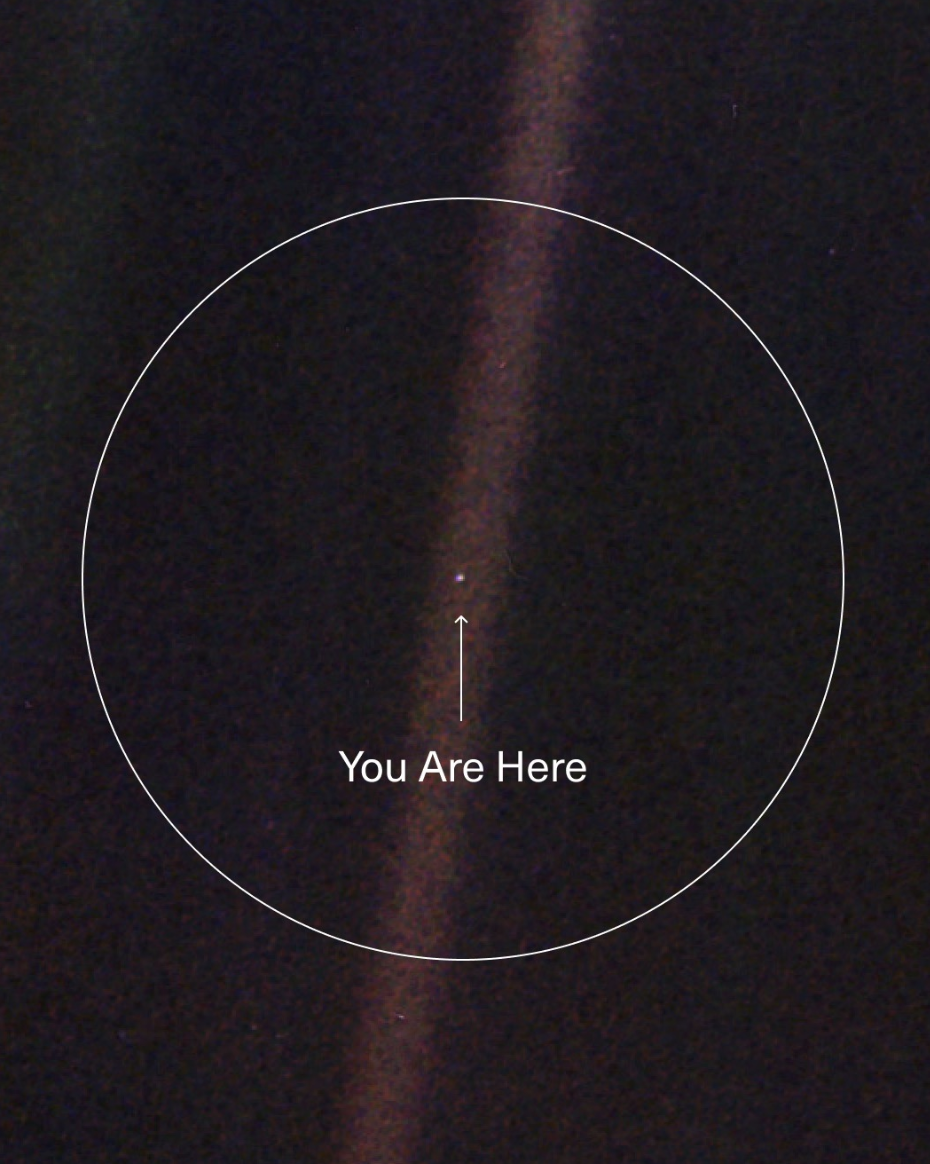
The great scientist, cosmologist Carl Sagan gave us his own perspective in a marvelous book entitled Pale Blue Dot. His book was inspired by an image (taken at his suggestion) by Voyager 1 on February 14, 1990. As the spacecraft departed our planetary neighborhood for the fringes of the solar system, it turned around for one last look at our home planet.
Voyager 1 was about 6.4 billion kilometers (4 billion miles) away and approximately 32 degrees above the ecliptic plane when it captured this portrait of our world. Caught in the center of scattered light rays (a result of taking the picture so close to the Sun), Earth appears as a tiny point of light, a crescent only 0.12 pixel in size.
Sagan’s thesis, in his own words, follows:
“Look again at that dot.
That's here.
That's home.
That's us.
On it everyone you love, everyone you know, everyone you ever heard of, every human being who ever was, and lived out their lives.
The aggregate of our joy and suffering, thousands of confident religions, ideologies, and economic doctrines, every hunter and forager, every hero and coward, every creator and destroyer of civilization, every king and peasant, every young couple in love, every mother and father, hopeful child, inventor and explorer, every teacher of morals, every corrupt politician, every "superstar," every "supreme leader", every saint and sinner in the history of our species lived there—on a mote of dust suspended in a sunbeam.
The Earth is a very small stage in a vast cosmic arena.
Think of the rivers of blood spilled by all those generals and emperors so that, in glory and triumph, they could become the momentary masters of a fraction of a dot.
Think of the endless cruelties visited by the inhabitants of one corner of this pixel on the scarcely distinguishable inhabitants of some other corner, how frequent their misunderstandings, how eager they are to kill one another, how fervent their hatreds.
Our posturings, our imagined self-importance, the delusion that we have some privileged position in the universe are challenged by this point of pale light. Our planet is a lonely speck in the great enveloping cosmic dark. In our obscurity, in all this vastness, there is no hint that help will come from elsewhere to save us from ourselves.
The Earth is the only world known so far to harbor life. There is nowhere else, at least in the near future, to which our species could migrate. Visit, yes. Settle, not yet. Like it or not, for the moment the Earth is where we make our stand.
It has been said that astronomy is a humbling and character-building experience. There is perhaps no better demonstration of the folly of human conceits than this distant image of our tiny world. To me, it underscores our responsibility to deal more kindly with one another, and to preserve and cherish the pale blue dot, the only home we've ever known.”
— Carl Sagan, Pale Blue Dot, 1994
Perhaps my vision that morning was a remembrance of having read Sagan’s book. Note that Sagan tells this to the reader without, to me, trying to prove anything. His words are so different from the conclusions of so many of us who have chosen to take a leap of faith to their “belief” in the truth of the words written over a period of five or so millennia by other human writers in so-called “scripture.” Infallible, literal words. If I may be so bold, I would suggest that writers such as Sagan are just as worthy of the title “prophet” as any of the sages named in the “holy” texts of other cultures, which are often conflicting. Truth, to me, must stand up to universal scrutiny and acceptance.
The market for religious belief has no monopoly on faith.
OK, no more theology for the moment. Back to music. It has not escaped my notice that Sagan’s “pale dot” was blue. My early morning hour is blue as well. Is that perhaps the missing link here that explains my “dream state”?
Are you aware of the origin of the term “blue hour”?
An online source explains it this way:
“The ‘blue hour’ (l’heure bleue) connotes a magical and fleeting transition between day and night (or dawn), characterized by a deep, tranquil blue light. It evokes feelings of peace, reflection, melancholy, and nostalgia, often representing an intimate, or ‘suspended,’ moment where the world feels calm and quiet.”
One of our finest observers of the natural world and host of an unequaled online site, The Marginalian, Maria Popova, brings us this vision:
“Blue, Rebecca Solnit wrote in one of humanity’s most beautiful reflections on our planet’s primary hue, is ‘the color of solitude and of desire, the color of there seen from here… the color of longing for the distances you never arrive in, for the blue world,’ a world of many blues—a pioneering 19th-century nomenclature of colors listed eleven kinds of blue, in hues as varied as the color of the flax-flower and the throat of the blue titmouse and the stamina of a certain species of anemone. Darwin took this guide with him on The Beagle in order to better describe what he saw. We name in order to see better and apprehend only what we know how to name, how to think about.
But despite Earth’s distinction as the Solar System’s ‘Pale Blue Dot,’ this planetary blueness is only a perceptual phenomenon arising from how our particular atmosphere, with its particular chemistry, absorbs and reflects light. Everything we behold—a ball, a bird, a planet—is the color we perceive it to be because of its insentient stubbornness toward the spectrum, because these are the wavelengths of light it refuses to absorb and instead reflects back.”
I am in deep water if I were to attempt to follow that.
But she and Sagan may just have made my point and answered my question. Where did my contemplative mind go during that most inspirational moment in memory? Or better yet, where did it take me? Please, if you will, help me here. Was my journey from the pale blue “dot-spot” to the very point of our origin more than metaphorical? It presents a great contrast to the creation stories of the world’s established religions.
If one wishes to have his faith story reach fruition as an affirmation of a life well lived, is existing in the “great mystery” enough? Or did the culmination of the journey end too soon? Was seeing at least a glimpse of the ultimate answer available, but not perceived? What more is being asked of human faith?
I have talked enough and will now let another human speak for me.
If I can claim a “spiritual” leader, the choice is simple: the monk and author Thomas Merton. He left us much too soon as he was moving towards finding a way to merge the faith journeys of Eastern and Western peoples. If one wishes to experience his thoughts on the individual “search for meaning,” you could do much worse than his New Seeds of Contemplation. In it, he seeks to awaken the dormant inner depths of the spirit so long neglected by Western man, to nurture a deeply contemplative and mystical dimension in our lives. It is much more accessible than it sounds. In essence, contemplation is his word for “prayer.”
A small sample to pique your interest:
“Every moment and every event in every man’s life on earth plants something in his soul. For just as the wind carries thousands of winged seeds, so each moment brings with it germs of spiritual vitality that come to rest imperceptibly in the minds and wills of men. Most of these unnumbered seeds perish and are lost, because men are not prepared to receive them: for such seeds as these cannot spring up anywhere except in the soil of freedom, spontaneity, and love.”
In the last few pages, he leaves the reader with this:
“The mask that each man wears may well be a disguise not only for that man’s inner self but for God, wandering as a pilgrim and exile in his own creation.
For the world and time are the dance of the Lord in emptiness. The silence of the spheres is the music of a wedding feast. The more we persist in misunderstanding the phenomena of life, the more we analyze them out into strange finalities and complex purposes of our own, the more we involve ourselves in sadness, absurdity, and despair. But it does not matter much, because no despair of ours can alter the reality of things, or stain the joy of the cosmic dance which is always there. Indeed, we are in the midst of it, for it beats in our very blood, whether we want it or not.
Yet the fact remains that we are invited to forget ourselves on purpose, cast our awful solemnity to the winds, and join in the general dance.”
So, I hope this heartfelt piece has spoken to you. As I reflect on my reason for creating this site, it has never been about becoming an authority (especially a model) about anything….
I share in order that you, the reader, might experience another person’s uncertain journey and know that they are not alone.
We can dance alone, but why?
Nothing I have encountered tells me that it is the only way—quite the contrary. Perhaps there is something to be discovered in setting aside the masks we create and wandering, for a time, as pilgrims, open to what might be revealed.
It is your life. Neither I nor anyone else can tell you what it means.
All I can say is that I am glad to be on this journey with you.